
Perimenopause Hit Early and Made Running Feel Harder Than Ever
At first, I blamed myself - then I connected the dots.

I fell in love with running by accident when I joined the track team the spring before graduating from high school – to this day, I hold the PB in 3200m at my small school with the time of 12:09. I’ve loved the sport through my 20s and early 30s, completing 15 marathons, a handful of half marathons, countless local 5Ks, and a one-and-done 50K in between four pregnancies. Technically, I qualified for the 2019 Boston Marathon but never made it to the starting line because my time was only a few seconds under the qualifying standard for my age group.
And then, out of nowhere, now that I’m knocking on the door of 40, I’d accidentally fallen out of love with running, and at first, I didn’t understand why. As life got busier, running took a back seat to work and my kids’ busy schedules. And when I finally felt ready to bring it back to the forefront in my late 30s, I couldn’t find my happy place.
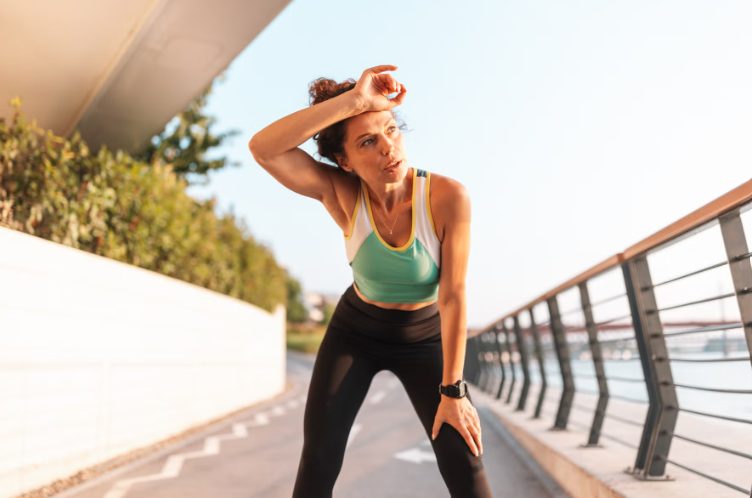
Running felt terrible. Despite weeks of consistent miles, I’d often feel as if I were closing in on a fast-paced 5K during these struggle runs, while my smartwatch yelled out my splits that were actually what should be my easy pace. My heart rate would suddenly spike: a workout that would have normally put me in the 140-bpm range was somehow skyrocketing me to the 170s or 180s. Plus, the out-of-nowhere heat intolerance made running in anything above 24-degree temperatures feel like hell on Earth. I felt chronically dehydrated while also needing to wear a pad for urinary incontinence thanks to four childbirths and a weak pelvic floor.
…I did some digging and started putting the puzzle pieces together. It wasn’t me; it was perimenopause.
I blamed myself at first. Was I that out of shape? Has anything happened to my grit? Why couldn’t I motivate myself when I was so dedicated and consistent in the past? But then I did some digging and started putting the puzzle pieces together. It wasn’t me; it was perimenopause.
During perimenopause, declining levels of estrogen make the body less effective at temperature control, blood pressure stabilisation, and oxygen distribution. Hormonal shifts in estrogen and progesterone also affect the autonomic nervous system by causing the heart rate to rise faster and stay elevated longer. It wasn’t all in my head; my body was just working harder to do the same thing.
As it turns out, perimenopause can start much earlier than many realise. And while menopause can be defined to a day – it’s when you haven’t had a period for 12 consecutive months, says Juliet McGrattan, a former general practitioner based in the UK who now specialises in women’s health and running – the start of perimenopause is hard to pinpoint. “Perimenopause, the lead-up to that when hormones are changing and you can get symptoms, can start up to 10 years before that day of menopause,” McGrattan says.
The average age of menopause is around 51, McGrattan notes, which could put the onset of perimenopause as early as 41. However, that’s the average; many women experience menopause earlier, so perimenopause can begin much earlier as well.
At first, I was in denial that I could be in the throes of perimenopause despite the many signs. I’m definitely within that age range, and I experienced period changes (whether it’s more frequent, heavier, or just more irregular), brain fog, anxiety, night sweats, hot flashes, low energy, feeling tired, breast tenderness, or, for example, gut changes, due to fluctuating estrogen and progesterone levels.
I was angry that running couldn’t be my effortless go-to place for grounding and escape. In my grief, I even questioned if I could still consider myself a runner.
Now that I know more about perimenopause, I’m slowly drifting toward acceptance, despite working through feelings of frustration. I’m not letting my pace define me, and I’m giving myself permission to slow down or walk for a bit to bring down my heart rate. I’ve gotten serious about hydrating and fuelling my body in a different way and committed to adding strength training back into my routine.
Life is still incredibly busy as a working mom of four. But I’m trucking along in my running journey as I adjust my goals, tweak my training, and shut off the setting on my smartwatch that loudly declares my kilometre splits.
How to Make the Perimenopausal Transition Easier
Musculoskeletal syndrome of menopause (MSM) is a collective term for symptoms triggered by falling estrogen levels, and something that begins during perimenopause, McGrattan says. She describes it as “feeling very achy, stiff, and like you’ve done a run when you haven’t; you can’t get out of bed in the morning, you feel like you’ve got DOMS [Delayed Onset Muscle Soreness] when you haven’t done a long run.”
“Those kinds of symptoms can be a big barrier for runners,” she adds.
Menopausal Hormone Therapy (MHT), which supplements estrogen and progesterone through pills, patches, gels, or sprays, might be an option for some women with more severe symptoms. For the rest of us, nonhormonal ways to address the struggles of running during perimenopause involve a shift in training, fuelling, and mentality:
Train Differently
Oftentimes, runners need more recovery time and less mileage overall during this period of their lives, says McGrattan, who is also the author of The Runner’s Guide to Menopause. “Previously, when you wanted to improve your running, you just ran more. But actually, at this time of life, sometimes it’s better to do a little bit less so that you can recover better from it,” she says.
Rethink Your Nutrition
McGrattan stresses the importance of an increased intake of protein, calcium-rich foods, and vitamin D in the diet, since our bodies become less efficient at absorbing these nutrients during perimenopause. Making sure to get enough of them can help offset the increased rate of muscle loss and higher risk of bone fractures that creep up during perimenopause.
Hydrating properly can also require a bit of adjusting. “Your estrogen and hormones are changing,” says Louise Valentine, a leading exercise physiologist and women’s integrative health practitioner specialising in female runners. “Therefore, water doesn’t cross the cell membrane as efficiently anymore. You have to change the osmolarity of it, meaning you put a little bit of sea salt in it with a little bit of lemon.”
Incorporate Strength Training
Adding in strength training becomes more important for women during perimenopause, since we experience accelerated loss of bone density. “That’s how I’m helping women drop 19 minutes off their marathon time when they were gaining weight, sluggish, slowing down, injury-prone, weren’t even sure they could run anymore,” says Valentine, who is also the founder of Breaking Through Wellness and the host of the Maximising Hormones, Physique, and Running Through Perimenopause podcast. “If you’re running all the miles, and that’s all you’re doing, your body is going to be chronically stressed; you’ll see things like A1C—or blood sugar dysregulation—all over the place, unexpected bone loss. So I really help runners slow down, learn how to align the female body specific to a runner, like we’re quad-dominant athletes; we’ve got to strengthen the back.”
Know That It’s All a Natural Part of Ageing
“In perimenopause, sometimes you can have a bit of an identity crisis because you might lose your confidence, you might not recognise yourself, be flying off the handle, be really sensitive,” McGrattan says. “And then you have an identity crisis of, ‘I don’t even feel like a runner, because I’m just completely rubbish,’ and that can be a significant issue for lots of women.” McGrattan advises staying open-minded and understanding that being a runner encompasses all shapes, sizes, and speeds. “Maintaining that identity as a runner, even if you feel like a bit of a fraud, is really important,” she adds.
This article first appeared on Runner’s World USA.
READ MORE ON: menopause perimenopause women's health