
If You’re Sitting All Day, You Should Stretch These Five Muscles
If you sit a lot, you need to give these muscles some love.

The notion that sitting isn’t good for you isn’t new, but if you think regularly running cancels out the negative side effects of sitting all day, well, you’d be wrong.
Sitting all day will make the front of your body tighten up…
Research indicates that no matter how much you exercise, sitting for excessively long periods of time is a risk factor for early death. And it definitely inhibits your exercise performance – you can’t, for example, sit for eight hours at work and then get up and run five miles without it affecting your body. All that sitting results in tight leg muscles and other issues.
“Sitting all day will make the front of your body tighten up, especially your hip flexors, rectus femoris (a quad muscle), pectoralis (chest), upper traps (upper back), and anterior scalenes (the front of your neck),” explains David Reavy, an orthopaedic physical therapist.
“When these muscles tighten up, it creates musculoskeletal imbalances. For example, tight hip flexors can cause an anterior tilt, which shuts down your abdominals and your glutes. So if you run after prolonged sitting, then those big stabilising muscles simply won’t work.”
Obviously, the best things to do would be a) practice good posture and b) stay active throughout the day. But because that’s often easier said than done, you have to warm up, says Rachel Straub, a certified strength and conditioning specialist and co-author of Weight Training Without Injury.
“If you put your body into full drive after it’s been at rest for an extended period of time, you are simply setting yourself up for injury.” That doesn’t necessarily mean you have to do an intense stretching session, but you should make time to stretch and open up these little muscles that may be extra tight after you’ve been riding that desk.
Here are the perfect stretches for after you’ve been sitting all day.
Your Pectoralis Muscles
Why you need to stretch them after sitting: “We tend to lean forward or slouch when we sit, which creates an anterior tilt of your ilium and scapula,” says Reavy. “That anterior tilt shortens your pecs,” (your chest muscles), which can lead to postural problems and shoulder pain, considering the rounded shoulder posture it can create.
How to open them up: “The best way to stretch or open your pecs is to perform movement patterns that pull your shoulders back,” says Straub. You can do this with foam rolling, stretches, or strengthening exercises, but her number one exercise for this is a reverse fly. “It strengthens your back and stretches your pecs,” she explains. “If your back muscles are weak, you will have a greater tendency for tight pecs. So, usually solving flexibility problems is best complemented by also strengthening the opposing muscle.”
Start standing with feet shoulder-width apart and dumbbells in hand. Hinge at the hips so that the back is nearly parallel to the floor and bend knees slightly. Let the dumbbells hang straight down, palms facing each other. Keeping back flat and torso steady, engage back muscles to lift arms straight out to the sides until they’re in line with the shoulders. Your upper body will form a “T.” Return to the starting position, then repeat for 3 sets of 12 reps.
If you do want a stretch, cross your arms in front of your body, then pull your arms back behind you as far as possible. At the end point, hold for 15-30 seconds, then repeat. You should feel a stretch in your pecs, along with contraction of your back muscles.
Your Hip Flexors
Why you need to stretch them after sitting: When you sit, your hips are flexed, and when your hips are flexed, the muscles of the hips shorten. “And if your hips are placed in a shortened position for an extended period of time and you don’t do exercise to extend the muscle back to a normal length, this then pulls your pelvis into a more forward position,” explains Straub. And that can lead to limited mobility and lower back pain, she adds.
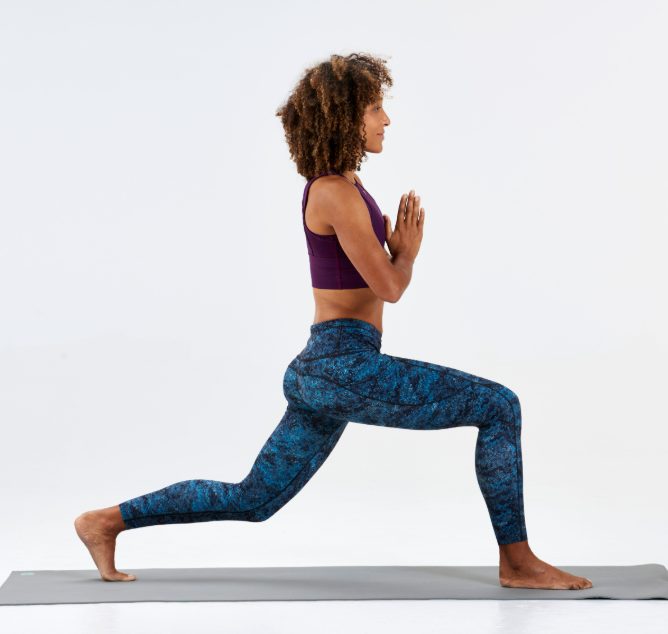
How to open them up: “You have to release your hips before you can stretch them,” says Reavy. Any muscle that bends the knee and/or pulls the thigh back will help. A simple lunge is hard to beat because it does both.
Stand tall (holding dumbbells in each hand at your sides is optional). Take a big step forward with the right leg and lower body until the right thigh is parallel to the floor and the right shin is vertical. Make sure the front knee is tracking directly above the ankle, and the other knee doesn’t touch the floor. (Both knees should bend 90 degrees.) Keep the weight in your heels. Press into the right heel to drive back up to stand. Continue on the right leg for 8 to 12 reps. Then switch sides. That’s one set. Complete 3 sets.
Your Spine Stabilising Muscles
Why you need to stretch them after sitting: “When you’re slouching, it puts extra stress on your thoracolumbar fascia – a membrane throughout the abdomen and lower back – and paraspinals,” says Reavy.
“Some of the biggest muscles attach to your thoracolumbar fascia, including your abdominals, lats, and glutes.” If these muscles don’t have adequate strength and/or endurance, the demands of sitting (or holding your core up) become too much, and you’re setting yourself up for pain.
How to open them up: Opening your hip flexors is key – they cross eight joints, including your entire lumbar spine. And then there are exercises that help: “Planks and push-ups require you to activate your spine stabilisers to maintain a neutral spine,” says Straub.
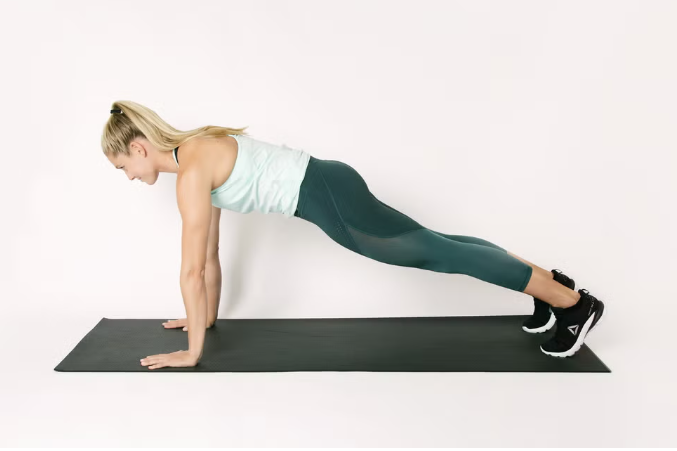
Start at the top of a push-up position, shoulders directly over your wrists. Draw shoulders down and back and engage abdominal muscles tightly to keep hips in line with shoulders so your body forms a long, straight line. Squeeze legs and glutes for support and hold this position for 45 to 60 seconds, or lower chest to hover above the floor before pushing back up to start for a full push-up.
Your Piriformis
Why you need to stretch it after sitting: Your piriformis is a muscle located deep in the butt, behind your glute max. “Sitting positions your pelvis in a way that doesn’t allow your glute to engage when you run or walk,” says Reave. “So what does engage? Your piriformis.” If that muscle gets too tight, it can shorten and put pressure on your sciatic nerve, adds Straub. The end result: agony.
How to open them up: The best way to do this depends on your level of flexibility. Pigeon stretch feels great to some people, but others might prefer to lie on their back and do the figure-four pose. A standing version can be easily adjusted to your flexibility level, says Straub.
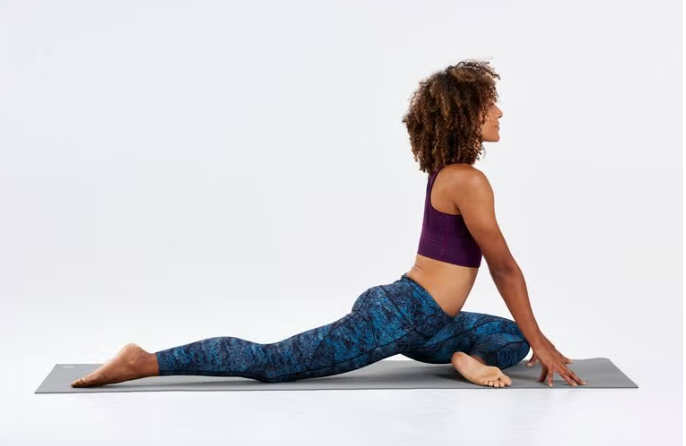
From a downward dog position, draw right knee to chest, then lie right shin on the floor so that shin is parallel (or almost parallel) to the top edge of the mat as you lower down to the mat with left leg behind you. Sit up tall, then walk your hands forward if that feels good for you. Hold for 30 seconds. Repeat on the other side.
If you’re too tight for the pigeon pose, you can try a figure-four pose.
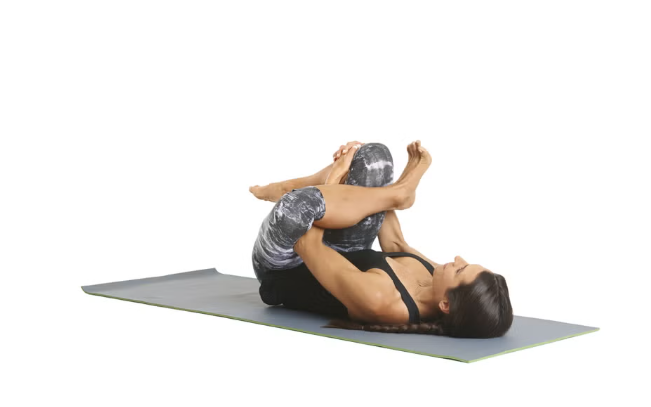
Lie face up with both knees bent, feet flat on the mat. Cross left ankle over right knee and keep left foot flexed. Thread your hands between your legs to grab behind the right thigh and pull the right leg toward the chest until you feel a stretch in the left hip. Hold for 30 seconds. Repeat on the other side.
Your Plantar Fascia
Why you need to stretch it after sitting: Your plantar fascia is the connective tissue that runs from your heel to the base of your toes. When you sit all day, it and other muscles of the foot tend to be in a shortened position, which can cause them to become tight, says Sophia Solomon, MD., a podiatrist in New York City. “When we stand up or go for a run following a full day of sitting, these tight muscles tug on our bones, leading to inflammation and painful bone spurs,” she says.
How to open it up: A targeted plantar fascia stretch can open up the connective tissue. Sit down, and place your foot across your knee. Using your hand on the same side, pull your toes back toward your shin until you feel a stretch in your arch. Run your thumb along your foot – you should feel tension. Hold for 10 seconds.
The best way to stretch the plantar fascia, though, isn’t really a stretch. Instead, roll your feet over mini foam rollers or a ball.
You can also point and flex your foot against a resistance band.
READ MORE ON: hip flexors Piriformis Syndrome Plantar fasciitis stretching