
Running Is Booming Again!
US major marathons are expanding to meet demand.

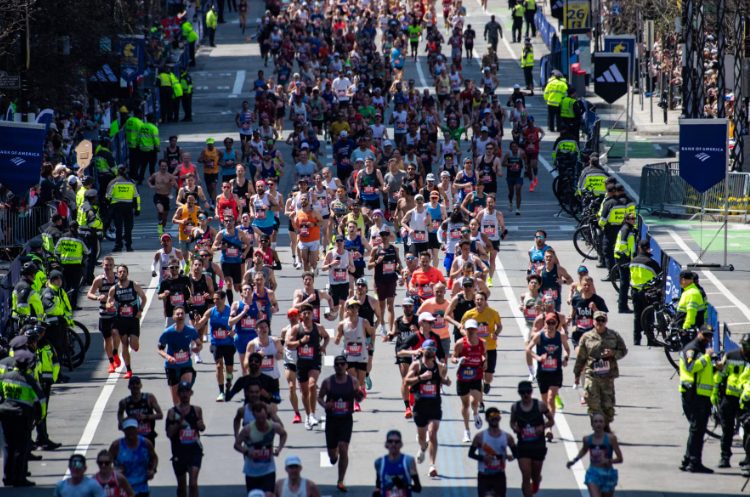
Running is no longer a niche pursuit reserved for elite athletes and die-hard endurance junkies – it has become a global movement, and South Africa is very much a part of the boom. Nowhere was this more evident than at the recent Cape Town Marathon, which welcomed a record field to the streets of The Mother City as it continues its bid to become Africa’s first Abbott World Marathon Major.
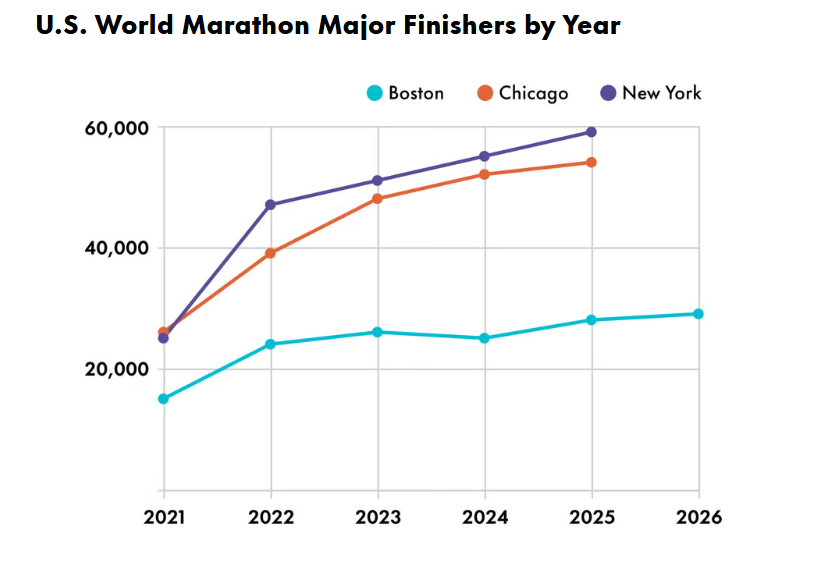
The number of finishers at the Boston Marathon used to be consistent, plus or minus a couple of hundred runners. For the five Bostons between 2015 and 2019, the finishers ranged from 25 907 to 26 762 each year, according to the Boston Athletic Association, which puts on the event.
What’s happening? It appears the American majors are trying to add athletes.
But as demand for marathons – especially the World Marathon Majors – grew after the pandemic, the field size has spiked in the two most recent editions of the race: There were 28 409 finishers in 2025 and 29 033 in 2026. The 2026 total represents a 9 percent jump from the 2023 number (26 623), which was a post-pandemic high. Boston finishers dipped slightly in 2024. What’s happening? It appears the American majors are trying to add athletes.
“The process to determine optimal field size is led by our operations team, who – especially in recent years – has worked with a crowd scientist to look at efficiencies and flow of athletes to determine where we can better optimise numbers/potentially have a few more athletes,” Chris Lotsbom, a BAA spokesperson, wrote in an email to Runner’s World.
The Boston team also consults with the cities and towns along the route and analyses historical data to predict the number of athletes who register but who do not start the race.
“We’ve been able to accept more participants in recent years (looking at 2025 and 2026 in particular),” Lotsbom wrote. “At the end of the day, we only have so much space on the roadway, and we want it to be an optimal, positive race experience for all.”
Across-the-board growth
Boston is not alone in growing its numbers. Chicago and New York City have seen bigger jumps in finisher numbers since 2023. Chicago’s 2025 race was up 12.2 percent from the race two years earlier; New York’s was up 15.1 percent. Its 59 219 finishers last November make the NYC Marathon the largest in the USA, and the second largest (behind London’s 2026 race) in the world.
“We work closely with the Mayor’s Office, city agencies, and crowd scientists to determine an appropriate field size for our events,” said Liv Ren, a spokesperson for the marathon, in an email. “That analysis takes into account a range of operational factors, including transportation, start procedures, course flow, street closures, and the time required to safely and efficiently reopen city streets.”
The race’s current permitted capacity is approximately 60 000 participants, she said, and “we are continually evaluating operational improvements and working with our city partners to explore opportunities to responsibly accommodate more runners in the future.”
A Chicago spokesperson also said the race seeks to provide an event that is “safe and enjoyable” for athletes, spectators, and volunteers.
“Interest in participating in the Bank of America Chicago Marathon remains high, and we look forward to welcoming more than 55 000 participants this fall, our largest field to date,” Alex Sawyer said in an email. “In recent years, we’ve grown the field incrementally to accommodate the increasing demand for participation while also maintaining the world-class race experience Chicago is known for.”
Considerations when determining Chicago’s field size include course safety, city infrastructure, and the “overall experience for participants, volunteers, spectators, local businesses, and community members.”
Not always smooth
As the races’ spokespeople point out, adding more runners to the field is a complex undertaking. And it doesn’t always go perfectly. Pre-race transportation is a common sticking point. In New York, many runners take the Staten Island Ferry and then get on buses to the start in Fort Wadsworth. In Boston, the race buses runners from the Boston Common to the starting line in Hopkinton, 26 miles west.
This year in Boston, many runners encountered a bottleneck at the bus-loading spot. According to Lotsbom, between 70 and 75 percent of the field takes a race-provided bus to the start; the rest of the runners find other ways to get there.
One runner, Greta Broneill, told Runner’s World she waited 90 minutes to get on a bus for the 2026 race; in 2025, she had no problems. “This year was just total chaos, with people panicking about their start times and almost being aggressive in terms of where they were in line,” she said. “It just was a totally different feeling at the Commons trying to get on the bus.”
In response to an email query from Runner’s World, Lotsbom said: “As we’ve had time to dive deeper into our post-race analysis, we are aware that some athletes faced delays at bus loading in Boston, and we are working hard to further understand the issues and determine what improvements can be made going forward.”
Where to put more runners?
Could the races continue to grow? Marcel Altenburg, who is a UK-based crowd scientist who works with all the World Marathon Majors, said that as races seek to add additional runners, it would be “mathematically” possible to grow the fields even more by extending the window of time during which runners start the race.
But there is a human toll on both runners and workers. Runners would have to wait for hours to start, and if the weather is bad, they would be exposed to the elements. And on-site workers, many of whom are volunteers, would have even longer shifts.
In Boston, the various divisions went off between 9:06am and 11:21 am this year. In New York in 2025, the race began with the men’s professional wheelchair race at 8am and with Wave 5 at 11:30am.
Chicago has a more compressed timeline – the men’s pro wheelchair race begins at 7:20am and the last of the waves starts at 8:35am. But the baggage check opens at 5:30am. In Chicago and other races, people are out working in the dark for hours before the race begins.
So could additional runners start later? In theory, yes. Reality might be different. “You just need the staff that are getting up at 3am to keep doing, doing, doing,” Altenburg told Runner’s World. “And then, yes, you could go higher.”
Additional reporting by Theo Kahler
This article first appeared on Runner’s World USA.
READ MORE ON: abbott world majors marathon running marathons