
My Running Life: Kimara Solms

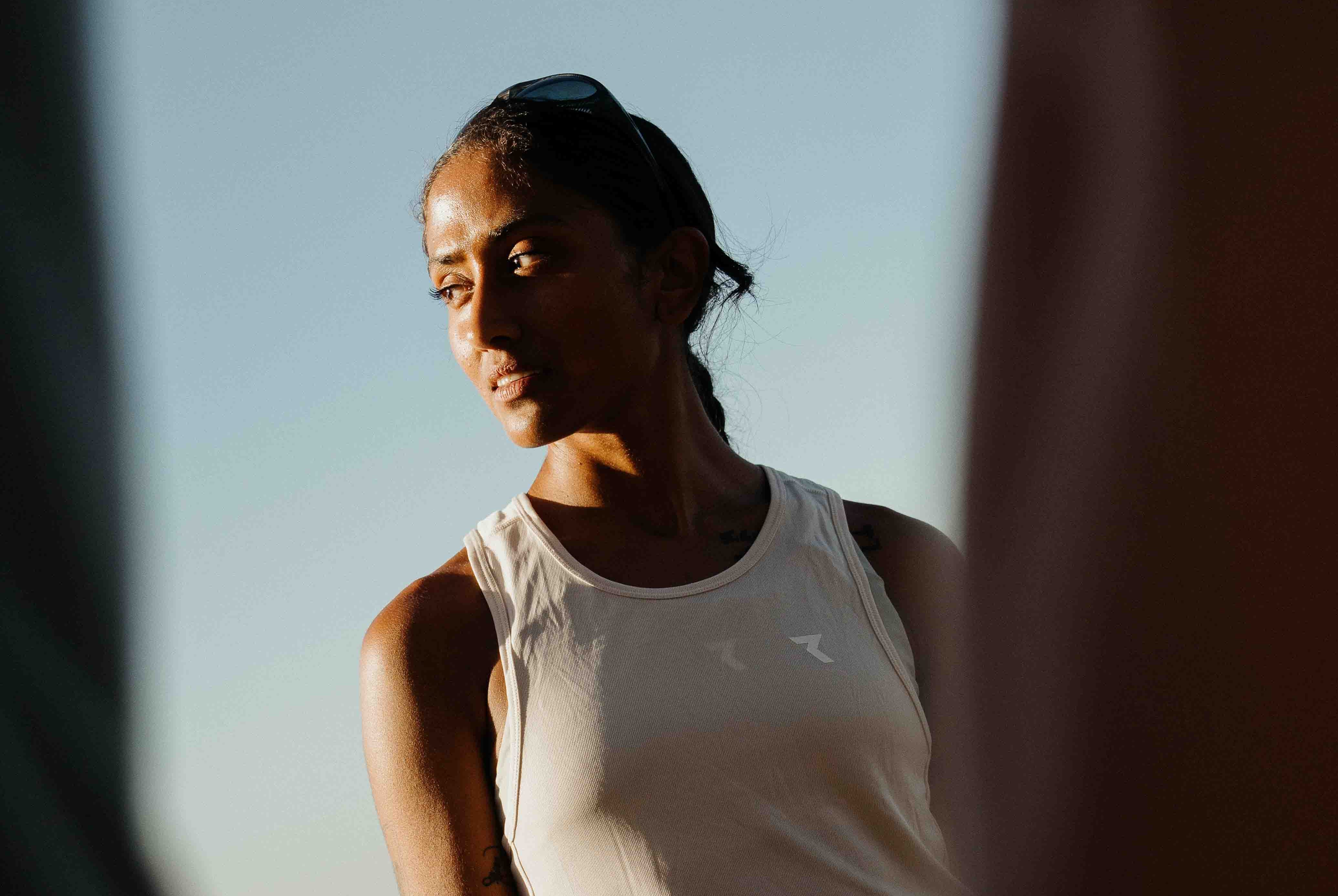
Kimara Solms, 28
PBs:
10km 36:08
Marathon 2:58:06
At 28, Kimara Solms is proof that the ‘sub-elite’ label isn’t reserved for runners who come up through the school track system. The Cape Town-based film producer started unsure if she could ever run a 10K; went on to run 1:52 for her first half marathon, in 2020; and only found a coach in 2022.
This year she ran a 10K in 36:08, and finished 10th woman at the Cape Town Marathon’s 10K Peace Run – after being seeded in A batch, <itals>behind the elite field she’d asked to start in. But her road to excellence has run through an eating disorder, a string of injuries, and years of slowly building volume around 18-hour work days.
Rachel Beaton caught up with Kimara to talk seeding snubs, threshold sessions, and why she doesn’t believe in failure. If you’re the kind of runner who secretly thinks they have the potential to make it to the big leagues, read this.
Rachel Beaton: Let’s start with the Peace Run. You were seeded in A batch, not the elite batch, and you still came top-10. What happened?
Kimara Solms: Oh my gosh… that was so much drama in itself. I told them I’d run around 36 minutes, and they put me in A batch.
Then I found out the elite batch would be separate; so I emailed them, and said I thought I qualified. Of course they overlooked me, because they didn’t really know who I was… But I’d run faster than a lot of the women in that field.
It is what it is. But I think that gave me a fire; I’d told them I could finish in the top 10, and I was going to show them I could. And so I finished 10th, even though I was seeded back, and I overtook quite a few women.
RB: A lot of people found that inspiring. It shows that if you work hard enough, elite status in this country is actually possible.
KS: It definitely is. Compared to other runners running similar times, I didn’t have the same trajectory. I just worked really, really hard. And one thing I do have is the ability to suffer! When you can do that, you can go really far.
RB: There’s plenty online about your running, but not much about you. What do you actually do?
KS: I’m a production manager and producer in the film industry. I got into film because I wanted to be an actor; and I’m still repped by an agent, I just do more producing.
But if I had to rank what I do, my life revolves around running. That’s where I’d like my life to go. Then acting, then filmmaking.
RB: Take us back to your very first race.
KS: I started school at four, and one of my first memories is of a 100-metre race. I beat everyone! I always ran at school, but casually.
When you come from an Indian home, the focus is academics; so there was no chance of me pursuing sport. That’s one of my biggest regrets, because there was always raw talent there.
RB: Your Strava bio says, “Running saved my life.” Where does that come from?
KS: When I was 15 or 16, I developed anorexia. I was severely restricting my food, and obsessing over exercise. At university it got worse, and I developed anorexia and bulimia. I really think now that if I hadn’t got a grip on it, my eating disorder would have killed me.
But when I started running, it became about how fast I could get, not how thin I could be. And you can’t get better at running without fuelling! It took time, but now fuelling myself is such a big part of my life. I also stopped smoking when I got my coach, in 2022.
I really do believe running saved my life.
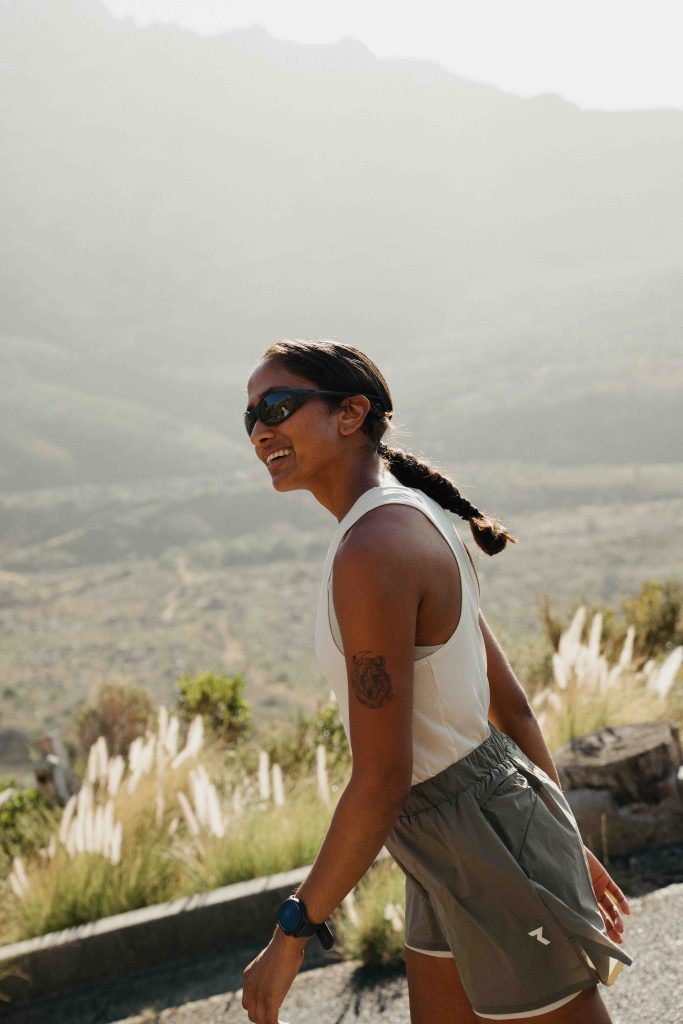
RB: So when did the running actually start?
KS: At university, I’d never even run a 5K. Then I started dating my now-husband, and running was how he kept fit. So in my final year, I started running casually.
I said to him, “I don’t think I could ever run 10 kays,” and he said, “No, you definitely could.” And almost immediately I was much faster than him, and I wasn’t even trying!
In 2019 I moved to Cape Town and joined Atlantic Athletics; and in 2020 I ran my first half marathon, in 1:52. I just wanted to break two hours.
RB: When did you decide to take it seriously?
KS: In 2022 I went freelance, to have more control over my time; and I found my coach, Neil Macpherson, a world championship triathlon coach. I wanted to see how good I could get.
Straight away, I got a stress fracture! But I’m a firm believer that there’s no such thing as overtraining; it’s really underfuelling. I was only running about 40km a week.
I was out for three or four months. Then I ran 1:37 at Gun Run – after two months of structured running, about 50km a week.
I thought, if I can do this after two months of proper training… I could run really quick.
RB: Then came the marathons.
KS: I improved my PB by 22 minutes in 2022, and again in 2023. But I only run one marathon a year, because I’m so injury-prone. In 2024 I went for a sub-3 at the Cape Town Marathon, and had the worst race of my life – stomach cramps. 3:05. Cape Town Marathon and I have beef!
But if I don’t believe I can do it, nobody else is going to. And I don’t really believe in failure. Just because I didn’t achieve a goal today. it doesn’t mean I can’t do it tomorrow.
RB: And Valencia last year?
KS: I wanted under 2:55, but I injured my big toe in the build-up; I ran 2:58. I broke three hours, but I was in much faster shape.
You’ll notice a pattern. Every time I have a goal and don’t reach it, the next year I want it bigger and better.
RB: This year, it all clicked…
KS: I got really comfortable running 100, 120 kays a week, and I hadn’t been injured in almost two and a half years. Before Spar Ladies I ran about 37 minutes for 10K inside a 40-minute tempo run, when my PB was just under 39.
Then I ran 36:45 at Spar Ladies, and that was a proper breakout race. People started following my running, and I’m now on Nedbank’s elite team.
And it wasn’t that I did anything different this year. I just kept doing what I’d been doing all along.
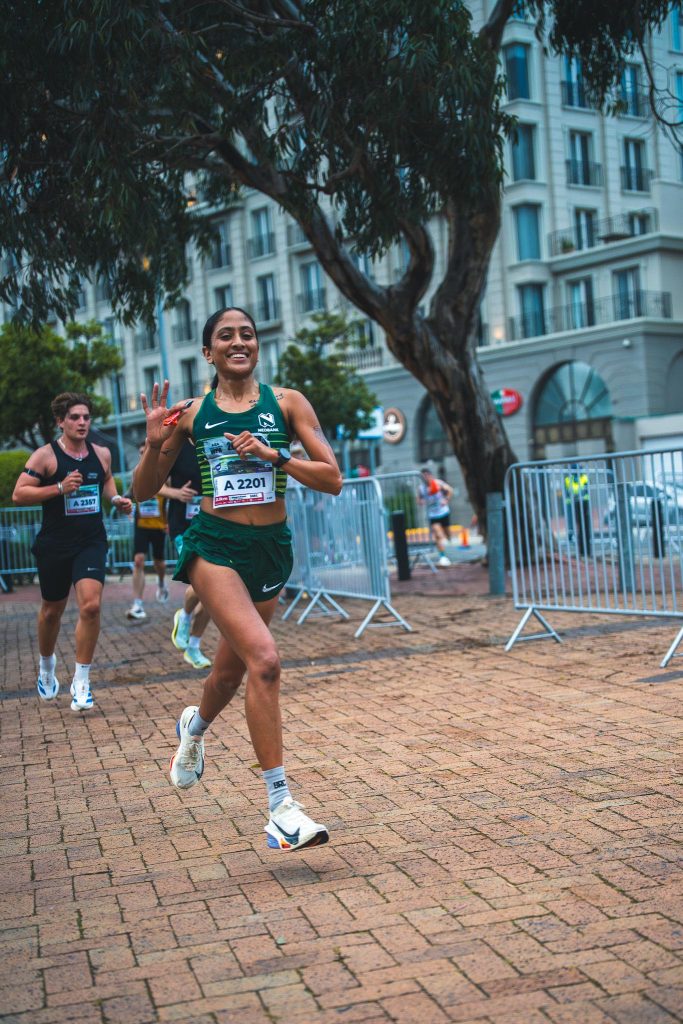
RB: What does a normal week look like right now?
KS: I’m training for SA Champs 10K, at 100km a week. Monday is an easy 10 to 12K, plus an easy 30-minute jog with my dog. Tuesday is a long, grindy threshold session, like 8K at about 3:50 a kay.
Wednesday is my long run: 20 to 27km with Carla Molinaro and others, with some marathon pace work. I’ll move sessions around for company, because running with people makes you faster.
Thursday and Friday are easy. Saturday is VO2 max work, 800s up to 1.2K reps. Sunday is an easy run, or a bike.
I don’t do as many reps as other people. I usually do four to six, maybe eight; but they’re really intense. I think that’s helped me get quick without getting injured.
RB: If one of our readers wants a faster 10K, what’s the one session they should do every week?
KS: Hands down, this one. It’s easy. But you need to learn how to be uncomfortable for a long time.
Do a 2- or 3K warm-up and cool-down; and in the middle, start with 20 minutes at half-marathon pace and try to build it, down towards 10K pace. If you’re really good, you can get to 40 minutes.
Do that every week, and you’ll get <itals>so quick. A 10K is literally a 5K times two. It hurts just as much, it’s just twice as long.
RB: What have you had to give up?
KS: Alcohol is a big one. I’m not teetotal, but before big races I won’t drink for weeks, because I recover better and feel so much poppier in speed sessions. Sleep, too. Don’t give yourself less than seven hours, and nap if you can.
I also have Hashimoto’s, an autoimmune illness, so I have to prioritise that. And I never, ever miss workouts. If I have to move things around, I will; but it gets done.
RB: How do you fit 100-kay weeks around the 18-hour work days when you’re shooting?
KS: I have a reputation, in a lot of production offices, for waking up at 3:30am to run. I have to run in the morning, because I can’t predict how the day will go. And if I can’t train on an 18-hour day, I get it done on another.
Sometimes, I have no social life – all I do is run and work. I don’t even see my husband.
RB: You’ve built close to 10 000 followers on your socials. When did the running content start, and does sharing it add pressure?
KS: When I stopped posting selfies and started posting about running, so many people unfollowed me! But then the running followers came. I’m just genuinely obsessed with running.
As for pressure, no one puts more on me than I put on myself; and I find sharing super-motivating. But I want people to see how I got here, because I want <itals>them to be able to get here.
RB: What goes on in your head when a race starts to hurt?
KS: The times I’ve raced best are when I was clear-headed, calm, and in the moment. I tell myself: focus on your breathing, focus on staying calm. Because the minute you think about your pace, your body tenses up – you’ll never catch me monitoring my watch.
Unless it’s the last kilometre, and I want it to end!
RB: If someone wants to improve, what are the top five things they should focus on?
KS: One, get a structured plan. That doesn’t have to mean a coach, because that’s not accessible for everyone; but find structure, otherwise you’ll wake up not knowing what you’re doing.
Two, build volume safely. I’m a runner who responds to volume, but it took four or five years to get here. If you’re running 50 kays a week, going to 70 will help.
Three: run your easy days easy, and your hard days hard. I run some easy days at six minutes a kay, because I’m running my hard days faster than most people. But don’t leave your race in a workout.
Four, fuel your body. Never run fasted, even for 30 minutes. Lots of carbs; and protein and carbs after you run.
And five, stay consistent; and that includes strength work. I <itals>hate strength training, it’s the bane of my existence. But I do at least 20 minutes a week. The only way to get faster is to stay injury-free and consistent.
RB: What do you use most in training, your top picks?
KS: Revive, every single day, with creatine and glutamine. People think creatine is just for building muscle, but it helps runners recover so quickly.
My favourite everyday trainer is the adidas AdiZero Evo SL. I have three pairs, and I alternate them with the Puma Deviate Nitro 4.
For racing, I’m a Nike Alphafly die-hard, from 5K to the marathon. But I’ll race my next 10K in the ASICS Metaspeed; it’s a good, stable, fast shoe.
RB: What’s next?
KS: A fast 10K at SA Champs. And before the end of the year I want to break 17 minutes for 5K.
Next year, I’m working on the Rotterdam Marathon in April, and I really want to run sub-2:45. I was in that shape before I got injured. I’d also love to run under 35 minutes for 10K.
Long term… I want to be a professional runner – someone who gets paid for running, not for creating content. I’d love to run a sub-2:30 marathon one day. Right now, I’m really good at the 10K; and if you have speed, you can go longer.
RB: Last one. For the reader who wants to break into that sub-elite bracket – what’s your advice?
KS: Find your ‘why’. Is it because running saved your life, because it brings you joy, or because you just want elite status?
You need unwavering self-belief, because no one else is going to believe it for you. I ran stride for stride with Caster Semenya once – this woman is my icon, I’ve read her autobiography, and I was thinking, what the hell am I doing here?
And don’t give up. Because often, people give up when they’re so close to a breakthrough. In 2024 and 2025, I was stagnant; and then 2026 came, and everything worked out.
Just believe in yourself, and keep staying consistent.
READ MORE ON: Human Race Profile