
Interview: King George The First

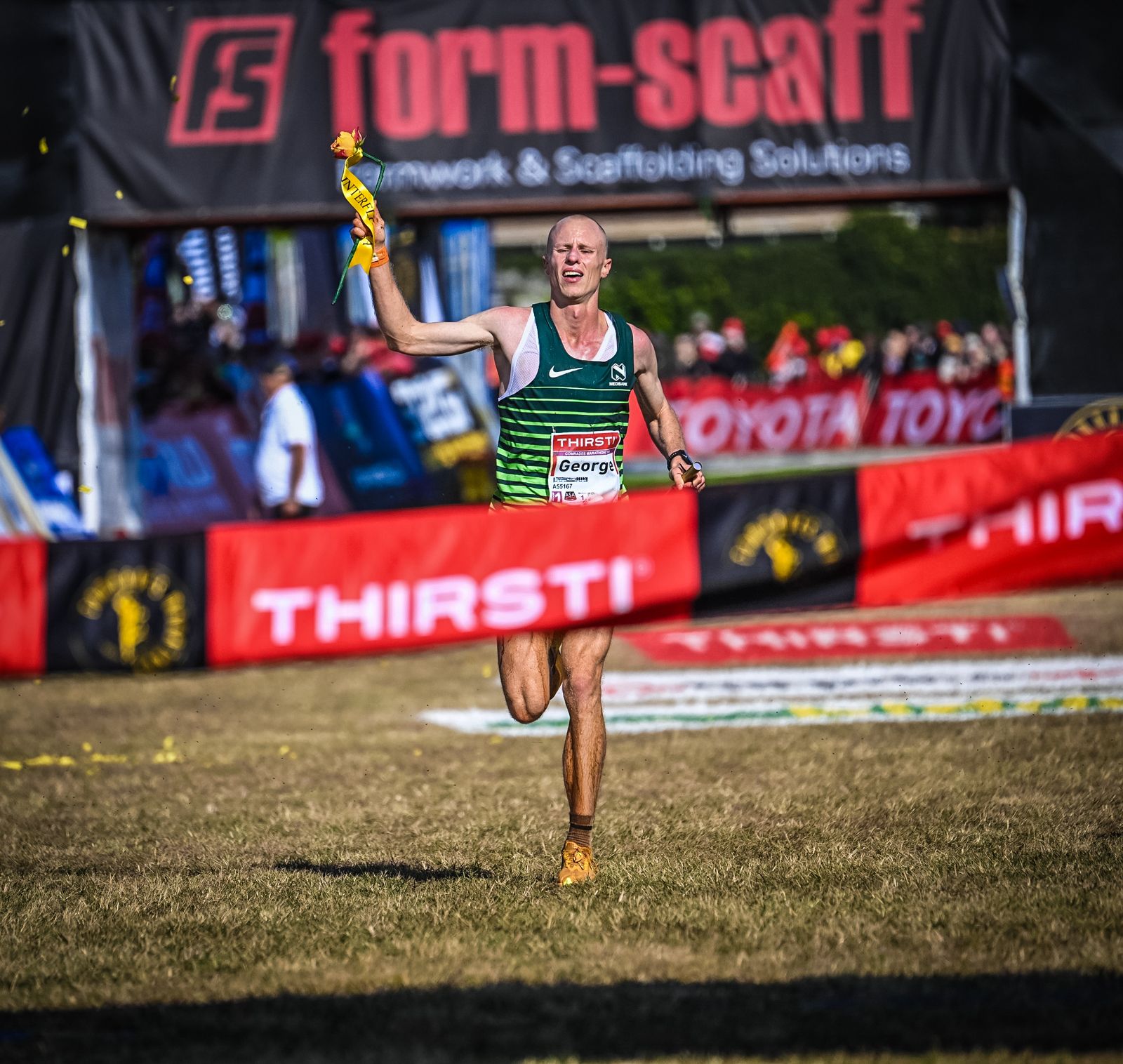
George Kusche, 27
2026 Comrades champion | Data Scientist | Father | Husband
@kuschegeorge
At 27, George Kusche has pulled off one of the fastest rises in Comrades Marathon history. The Pretoria-based data scientist finished 12th in his Comrades debut in 2025, then came back a year later and smashed the 18-year-old ‘Up’ record, crossing the line in Pietermaritzburg in 5:16:06. Amazingly, he coached himself using his own read of the data and a training platform he built on the side.
Rachael Beaton: Let’s start with the basics. You’re a full-time data scientist, you have a wife and a son (George Junior), and you… just won Comrades. What does a normal day look like?
George Kusche: I’m in the office three days a week – Monday, Tuesday and Thursday – and work from home on Wednesday and Friday. On office days I wake up between 3:30 and 4am, start running in Joburg from around 4:30, then shower at the Planet Fitness in Sandton before starting work at 8. I finish around 4pm, drive home, and have dinner with my family.
I don’t really double up on those days. Even if I wasn’t running, I’d have to leave early to beat the traffic anyway; so I’m not losing family time to training. On work-from-home days I still run in the morning, but I’m more relaxed about it. I can eat breakfast, start work a bit later; and if I need a second session, that’s the day I’ll do it.
RB: Being a data scientist clearly shapes how you train. What’s the most common mistake you see Comrades runners making in their training?
GK: Being too fixated on fancy workouts, trying to tick every box. A threshold session, a VO2 max workout, hill repeats, a tempo run – all in the same week. I don’t think you need all of that, and I don’t even do it myself. Take a simpler approach, whether you’re a social runner or an elite; but know <itals>why you’re doing what you’re doing, rather than just following a formula.
Most people should run easier and slower than they think. I do a lot of my running at 5 minutes a kilometre – sometimes slower, if I’m tired. I’m not worried about how it looks on Strava, because I’m playing the long game.
RB: You were chasing a pro track career in the US before this, and then took a full year completely off running. What was the logic there?
GK: The logic was that I was done with running! I was chasing a pro career, underperformed, and got mono <itals>[Mononucleosis – which we know as glandular fever – is a contagious viral illness characterised by extreme fatigue, severe sore throat, and swollen lymph nodes. – Ed].<end itals> The bad thing about mono is you don’t necessarily feel sick; you’re just extremely fatigued.
I kept training through it, and my performances fell off a cliff. I went from running six 400m reps at 52 seconds to not being able to run one in 60. That took the enjoyment out of it completely. I recovered, and had a decent final NCAA <itals>[National Collegiate Athletic Association]<end itals> year; but nowhere near what I knew I was capable of.
Then… life happened. I had to get a job, and grow up; and I thought, why keep chasing something that clearly wasn’t working out? So I stopped – completely – and told myself I was done forever. I lifted weights instead – bench, deadlift, squats – got strong, got bored, and put on a lot of weight. I was 86kg in October 2023!
RB: And now?
GK: 62kg.
RB: Wow…
GK: But I missed running, and I figured, I’ve already stopped completely, so why not just try again? It’s better than never running again.
I didn’t think I’d ever run Comrades! I thought maybe I’d do a few local 10km and 21km races, and enjoy it as a serious amateur. I ran a 31-minute 10km to start, then a 21km, and I could feel myself improving every time I trained harder. Which felt good – like I had control over my own performance again.
I ran the Cape Town Marathon in October 2024, exactly a year after I picked running back up, in 2:20. It wasn’t incredible shape by any stretch, but it was the best I could do that day. Someone told me afterwards that time would have qualified me for the Comrades elite field, which I didn’t even know. That planted the idea.
I’m part of Nedbank Running Club, so I asked to be entered for the 2025 edition. Then, in January 2025, I tore an ankle ligament at a half marathon, and lost five weeks of training…
RB: And you <itals>still finished 12th on debut.
GK: I started training again at the end of February, weighing around 70 to 71kg, and did everything I could with the cards I’d been dealt. Twelfth was the best I could do on the day; I don’t think I could have pushed harder.
But afterwards, I thought, that’s a good start – so why not go all in?
I’ve come a long way since October 2023. I sat by myself after that race, and decided to give it everything for the following year.
RB: Last one – when did it actually get hard for you, at Comrades?
GK: Around 52 to 56km. I saw a board saying 32km left, so I was about 53km in, and my legs started sending signals that they were tired. With about 25km to go, my left calf started cramping; every time I landed on that foot, it was like a stabbing pain. That’s when it got properly tough…
BONUS ONLINE CONTENT…
RB: Obviously the average runner isn’t doing your kind of volume, but they’re juggling the same job, family and running triangle. What’s the one thing from your routine that scales down to a normal runner’s life?
GK: I put in more hours than the average runner, but the principle’s the same. Get it done early. It’s not convenient, and you’ll get slightly less sleep, but it’s better to sleep a bit less and get the training in than sleep in and skip it. As a social runner, you don’t need to double. Just get the run done in the morning and go about your day. Eat the frog first thing.
RB: In a previous interview you said that in the closing kilometres of Comrades, you weren’t thinking about winning, you were afraid. And that fear actually produces better performances than confidence. Why does fear work better as a driver?
GK: It’s process-based thinking versus outcome-based thinking. Comrades is 85 to 90km. There’s no way you’ve repeatedly run that distance and feel comfortable with it. With a 5k, 10k or 21k, you can prepare by actually racing those distances, so by race day you’re confident you’re physically adapted and roughly know your pace. Comrades is too complex for that. It’s too far, and there’s too much that can go wrong: cramps, a twisted ankle, fatigue, stomach issues. So I take the approach of being curious. I’ve done the training, and I want to see how well I can perform. Saying I’m going to win signals a level of confidence that a race this complex doesn’t really allow for.
RB: So you say that your long runs were mostly around 5 mins/km but your Comrades pace was 3:38 mins/km. What’s the thinking there?
GK: Because I want to maximise my aerobic conditioning, and running at 3:40 puts me almost into an anaerobic state. I don’t think I need that stimulus, especially not for Comrades. If you run at race pace too often, you can’t sustain high volume over six months, and race pace is open-ended anyway. I genuinely didn’t think about running 3:38 before the race. I just focused on being in the best shape possible and executing on the day, and it came out at 3:38 per km. I see a lot of runners get anxious in training, trying to prove to themselves they can hold race pace before race day, and I think that takes gains away from race day itself. I’d rather chase my threshold pace. I know if I can run a 64-minute half marathon comfortably, I can sustain a fast Comrades pace, without ever having specifically rehearsed that number.
RB: So if most of the week is easy, how many actual workouts, long run progressions, intervals, should be in there?
GK: For Comrades specifically, I did at most two hard sessions a week, but usually just one, on a Friday. Track intervals or around 20km of threshold work. Everything else was easy, including my long runs. I’ve never actually done a long run progression. There’s a lot of reading and trying to optimise a programme, but honestly it comes down to consistent volume.
RB: For the average runner without your background or your dashboards, how do they tell the difference between overtraining and just being uncomfortable?
GK: Track your resting heart rate. If it’s elevated for weeks at a stretch, that’s a sign you’re either sick or overtrained. If it’s low or normal, you’re probably fine. Then look at the quality of repeated workouts. I did the same session every Friday for four months before Comrades, and my heart rate stayed the same while my pace kept improving. If you’re overtrained, why would that be happening? Same with half marathon times. If they keep coming down without you working any harder, you’re not overtrained.
RB: Your background is middle distance running. Your winning move this year came from those surges on Inchanga. How much of that do you put down to your track background?
GK: The training structure I follow – Friday workouts, Sunday long runs, lifting on Mondays and Wednesdays – comes from my time as a shorter distance athlete in the US, and that helped a lot. But I had to reinvent myself as an athlete for Comrades. I didn’t touch the kind of speed work I would have back then. The surges on Inchanga were pure improvisation. I was running next to a strong athlete and could hear he was breathing harder than I was. So I figured if he was struggling, the rest of the field probably was too. I didn’t want it to be a comfortable race, so I gradually picked up the pace, hoping the group would follow. If they didn’t, I’d just be burning my own matches. Luckily they came along. I did that four or five times, backing off in between, and on the fifth surge I just didn’t stop. That’s where I broke away. I caught Mbuti Mollo with around 8km left and ran as hard as I could to the finish.
RB: What does your diet look like on a normal training week?
GK: Coffee and rusks every morning, training or not. On long run days I’ll add a bagel before I head out. Then toast and eggs for breakfast, chicken and rice for lunch, and steak and vegetables for dinner.
RB: You’ve had stomach issues at Comrades two years running now. What do you think is causing it?
GK: I thought last year was a one-off, so I didn’t specifically try to prevent it this time. I think it’s the distance combined with carb intake. I topped out at about 90g of carbs an hour in training, but on race day it was closer to 120g. I’d rather flip that around and practise the higher number in training so I know it’s not the nutrition. It might just be the distance. I never really run that far in training, so to some degree it’s still an unknown for me. I’ll be more aggressive with nutrition training before the race, especially in long runs.
RB: You’ve also just launched a coaching platform, Go Run More. Tell me about that.
GK: It’s a software platform that a friend and I built. He’s an actuary with a strong interest in software engineering, and data science obviously overlaps a lot with that. It’s similar to TrainingPeaks, but it’s our own, and it incorporates things I used to track myself in the build-up to Comrades. Every run’s heart rate, distance and pace plotted on a 3D graph, so I could see where different types of workouts should sit. We formalised that into Go Run More. The long-term goal is for coaches and athletes to be able to find each other on the platform. A high school coach, for example, could sign up and only take on high school athletes, or a parent could log in and see exactly what their kid was assigned and what they actually did. Since it’s our own platform, if someone wants a new feature, we can just build it. For now, I’m the only coach. I’ve taken on a few athletes as testers, and we’re planning to officially launch to the public in September.
RB: What’s different about your coaching compared to the hundreds of other Comrades coaches out there?
GK: Well, it obviously works. I coached myself, and it worked. I’d say the other big thing is making intuitive adaptations rather than sticking to a rigid plan. Plenty of coaches have the knowledge, but adapting on the fly is where it actually gets hard, because there’s no universal right answer. Compound those decisions over five years, and that’s where coaching genuinely adds value. It’s like investing. One decision won’t move your portfolio much, but all of them over 10 years matter a lot.
RB: If you were coaching someone to their first Comrades, or to a PB, what would be the top things you’d have them focus on?
GK: Consistency, without a doubt, is the most powerful thing. I’d want to help keep them accountable, because knowing someone’s invested in what you’re doing helps you stay consistent. Then easy volume, with a few specific workouts mixed in, and being very careful not to overdo the intensity. Telling someone to do hills today, threshold tomorrow, tempo the day after, that’s lazy coaching. I’d rather someone be slightly undertrained than overtrained, to borrow from Bruce Fordyce.
RB: In a previous interview you said you’re hoping to follow in Gerda Steyn’s footsteps. She’s just won her fifth Comrades title. Realistically, what does the next decade of Comrades look like for you?
GK: I think I’ll be running Comrades until I’m 40, with the exception of Olympic years. I’d like to try to qualify for the marathon at the Olympics. 2028 would be the right time. I’m running the Amsterdam Marathon in October this year. Not looking to qualify yet, but if I can take a step in that direction, I’ll be happy.
RB: And coming back to defend next year, are you chasing the record again, chasing the win, or just chasing your best?
GK: Process, again. I’m going back to the drawing board to see how well I can prepare. You can never recreate exactly what you did before. I need to become a new, better athlete capable of winning again, without trying to copy last year’s training, because that’s when mistakes creep in. New year, new race, new me, in a sense. I won’t be focused on winning or on a time; both of those are outcome-based. I’m focused on preparing well and executing on the day. If I do that, I trust the results will follow.
RB: Last few. I put a call out on my socials for questions. First one’s my favourite. Are you okay?
GK: Yeah, I’m okay. Why, what indication am I giving that I’m not?
RB: You run Comrades, George. I think they’re checking on you mentally.
GK: Fair, probably not, then.
RB: Top tip to stay injury-free?
GK: Reduce intensity. A lot of injuries come from hard workouts done without knowing why you’re doing them. Replace your shoes at least every 700km. And eat enough… don’t underfuel. That’s a big one too.
RB: What’s more boring, George: Running on a treadmill, or actuarial science?
GK: Running on a treadmill, easily. Not even close. I haven’t touched one in years… it’s the worst.
RB: Should amateur runners be obsessing over Zone 2?
GK: Not really. I don’t even know exactly what Zone 2 means for me. Focus on running easy and increasing your volume over time in a sustainable way, which does mean running easy for about 90% of what you do. Just don’t try to run as much as possible next week, build it up.