
Behind the Scenes of the Cape Town Marathon
The scale of the operation behind the scenes is what truly powers the event.

As thousands of runners prepare to take on the Sanlam Cape Town Marathon, the economic impact of one of Africa’s biggest road races is already being felt across the Western Cape. From tourism and hospitality to transport, logistics and temporary employment, the event is expected to contribute more than R800 million to the regional economy this year.
An estimated 8 500 international runners are set to travel to Cape Town, joining thousands of local participants and supporters for a race weekend that extends far beyond the finish line. Hotels, restaurants, transport providers, tour operators and local suppliers all stand to benefit from the influx of visitors.
The three-day Cape Town Marathon Expo is also expected to draw more than 60 000 visitors, further cementing Cape Town’s growing reputation as a global destination for running and major sporting events.
But while race day may capture the spotlight, the scale of the operation behind the scenes is what truly powers the event — months of planning, coordination and logistics long before the first runner crosses the start line.
Staging an event of this scale depends on a broad ecosystem of organisers, suppliers, logistics providers and support teams. For Coca-Cola Peninsula Beverages (CCPB), preparations begin up to six months in advance, spanning manufacturing, warehousing, transport and on-the-ground operations.
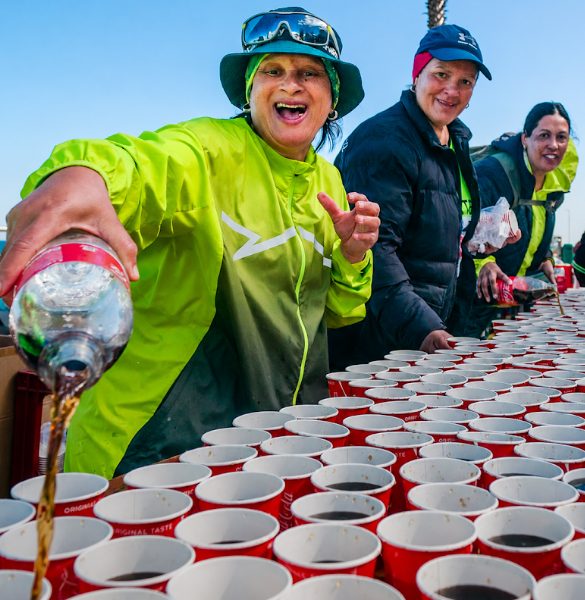
…approximately 183000 litres of water, 23000 litres of Powerade and more than 1.2 million cups, supported by 50 tons of ice…
This year’s effort alone is expected to involve approximately 183 000 litres of water, 23 000 litres of Powerade and more than 1.2 million cups, supported by around 50 tons of ice to help keep participants hydrated throughout marathon weekend. Race weekend itself becomes a 24-hour operation.
Overnight crews prepare stations while vehicles move product before most of the city is awake, and teams are still working long after the last runner crosses the finishing line.
“Supporting an event such as the Cape Town Marathon is a months-long operation involving people and teams from across our business,” says Dan Davis, Commercial Activations Lead at CCPB. “Planning begins well before race weekend and involves extensive coordination with the event organisers on route logistics, refreshment stations, the finish village and the expo, all to make sure runners have access to hydration when they need it.”
“The scale of what happens behind the scenes is something most people never see,” adds Marc Odendal, Commercial Sports and Marketing Assets Lead at CCPB.
“Runners and supporters might only see our team members handing out refreshments along the route, but backing them up are hundreds of people working to help make the event happen.”
This year’s event carries added significance. Following the 2025 edition’s cancellation due to severe wind conditions, extensive contingency planning has been built into preparations by race organisers to help ensure every aspect of the event proceeds safely and successfully this year.
“Whether someone finishes in record time or misses the cutoff, we want every person taking part to feel supported,” says Davis. “For us, success is making sure every runner has access to hydration and crosses the line safely.”
The Cape Town Marathon takes place on Sunday 24 May 2026 and is Africa’s only Abbott World Marathon Majors candidate.
READ MORE ON: cape-town-marathon race statistics World Marathon Majors