
3 Nerve-Flossing Moves to Help Ease Common Pain Points
Add this technique to your warmup or cooldown.

From run club chatter to social media posts, the term nerve flossing seems to be popping up more and more in running vernacular. And while it may sound a little woo-woo, physical therapists say they have seen it benefit runners firsthand.
Nerve flossing, which is also called nerve gliding or neurodynamic techniques, uses controlled movements to help nerves glide smoothly through surrounding tissues, to improve mobility and reduce nerve-related symptoms like sciatica, says Emily Shrekgast, DPT, a physical therapist at Bespoke Physical Therapy in Hoboken, New Jersey.
Runners may be prone to neural sensitivity, thanks to the repetitive stress of running and getting overly tight from not cross-training, which is why we may benefit from nerve flossing. So if you’re constantly feeling achy or sore, especially in the lower body – or want to avoid feeling that way – here’s what to know about the technique, plus moves to try at home.
What’s a Common Cause of Neural Sensitivity in Runners?
Injuries, herniated discs, conditions like diabetes, or even long periods of sitting can cause nerve-related weakness, numbness, or pain.
“If you’re sitting all the time, your hip is flexed, your knees are bent, so that adds a lot of slack to the nerves in the back of the thigh,” explains James Chung, DPT, a Kinstretch instructor and physical therapist at MOTIVNY. If you then go straight from your desk into a run, you could feel a sensation in your nerves first as a way to “protect” the muscles and joints – it’s essentially a signal to pull back so you don’t get hurt.
What Is Nerve Flossing?
Nerves are embedded in muscles throughout your whole body, says Paul, and they can cause tingling or numbness in your back, arm(s), leg(s), hand(s), feet – pretty much anywhere.
Nerve flossing is meant to improve the mobility of how those nerves course through various parts of the body, she says, so rather than a sustained stretch, nerve glides are gentle and repetitive—and typically not done to your full range of motion. (Think: rather than a hamstring stretch at your end range, you stretch just until you feel a slight tug, then back off.)
Chung says there are two types of nerve flossing: The first is called a tensioner, and you can think of it kind of like trying to pull a piece of gum apart; you’re putting tension on both ends of the nerve. The second is called a slider, and it’s when you attempt to lengthen or move the nerve on one side but keep it slack on the other, which is similar to the motion of flossing between your teeth, Chung says. The latter is the type he’d use if a patient has more significant irritation or sensitivity, as tensioners can be more intense.
The goal of both is to desensitise the nerves to enable your muscles to move through their full range of motion without your body pumping the brakes as a result of nerve tension, Chung says. (Exactly how this works on a physiological level is still being researched, he adds.)
Still, nerve flossing may not be the best intervention for everyone. “Contraindications include acute nerve root irritation, severe pain reproduction during the movement, or if the movement significantly increases symptoms afterwards,” Shrekgast says, adding that your best bet is to get assessed by a physical therapist. “Acute nerve irritation” refers to a sudden injury or event where a nerve becomes inflamed, irritated, or compressed, which leads to symptoms like sharp pain, numbness, tingling, or weakness.
For runners, however, nerve irritation is more commonly related to overuse or mechanical issues that develop gradually over time so nerve flossing can be used to manage similar symptoms and help to maintain nerve mobility, like when you use them in a warmup, Shrekgast adds.
How Can Nerve Flossing Help Runners?
Chung has noticed in his practice that runners can be prone to nerve tension or sensitivity, especially if they don’t do much cross-training, because running itself doesn’t require a lot of range of motion.
Paul agrees: “If the muscles are tight because they’re either overworked or they’re weak, then that can kind of clamp down on that nerve tissue and cause some problems.” Shrekgast adds that the repetitive impact of running, especially at high volumes and/or when recovery isn’t sufficient, can increase irritation or compress nerves.
In an ideal scenario, Chung says, runners would have a well-rounded routine that includes mobility drills and strength training, which inherently help protect against nerve issues.
“If you do really good strength training that brings your muscles through their full range of motion, [nerve flossing] is almost cooked into it,” he says, citing a Romanian deadlift as a good example. “It provides the same kind of tension that a nerve floss would because your nerves stretch when you move,” Chung says, adding that this move, in particular, may help with sciatic nerve sensitivity.
Paul adds that while nerve flossing is indeed a good “tool in your toolbox,” it’s important to understand the underlying cause of any nerve tension, whether it’s a lack of strength, overtraining, or something else. A physical therapist can help properly address the root cause and guide safe rehabilitation and return to running, says Shrekgast.
Now, even if you currently don’t have any nerve pain, Chung says that many of these techniques are generally useful for flexibility because they help make your nerves less sensitive to stretching.
How to Nerve Floss
The experts agree that prerun, as part of a warmup, is good timing for nerve flossing, as it can help reduce that neural sensitivity you may otherwise experience while running. You can also do these moves postrun as part of a cooldown to help alleviate any irritability the run may have caused.
Chung and Shrekgast flag that if you do these moves as a warmup, put them at the end after you’ve gone through other moves (such as general dynamic stretches) first, because they’re more likely to be effective, and less potentially irritating, when you’re warmer.
“Warming up before nerve flossing increases blood flow, improves tissue mobility, and reduces stiffness in the muscles and joints surrounding the nerves,” Shrekgast explains. “This helps the nerves move more freely, making nerve flossing safer, more comfortable, and more effective.”
In general, as you go through the movements, be mindful not to hold any of the positions for longer than a couple of seconds, which can irritate the nerve, Shrekgast says.
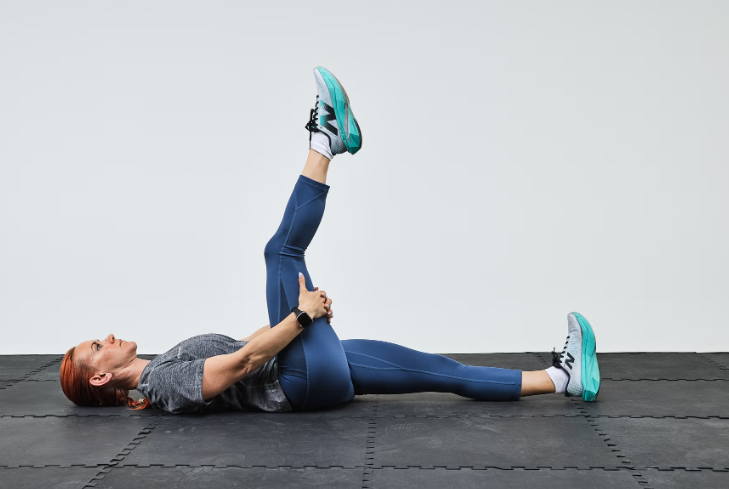
Supine Sciatic Nerve Glide
What it works: For Shrekgast, nerve flossing is a go-to for patients who have sciatic-type pain, which is when pain travels along the sciatic nerve that runs from the glutes and down each leg. However, she and Paul stress that sciatic pain can vary in both cause and severity, making it a good idea to be evaluated by a physical therapist who can provide personalised treatment. That said, the following is an example of a nerve glide they might prescribe.
How to do it:
- Lie faceup. Hug one knee to chest so the hip is at a 90-degree angle and hook hands behind the thigh.
- Flex the foot (toes toward shin) and start to extend the knee. Straighten until you feel a slight tug on the hamstring.
- At the top, point the foot, toes away from the shin.
- Bend your knee back to 90 degrees.
- Repeat for 10 reps.
Elephant Walk
What it works: Chung sees patients with neural sensitivity in their hamstrings or lower back, or tightness in their calves, and says the following move—which is a tensioner—could help in these cases, as well as with sciatic pain.
How to do it:
- Stand with feet hip-width apart, facing a chair. Fold forward at the waist and place your hands on the chair, legs straight. (Place elbows on the chair to get a deeper stretch.)
- Bend the right knee, lifting the heel, keeping the left leg straight to feel a stretch in the back of the leg.
Straighten the right leg as you bend the left leg. - Continue alternating sides, doing 10 reps per side.
Slump Flossing
What it works: Chung uses this flosser as a screening tool since it may elicit nerve-related symptoms for some people in the calf and for others in the back of the knee or even in the back. “If it does elicit symptoms, it’s used as the intervention because it can desensitise you to those symptoms,” he says. This may ultimately allow you to have more range of motion in these areas (if nerve symptoms were previously limiting it).
How to do it:
- Sit on a bench or chair with your hands clasped behind your back.
- Slump forward so the chin is on the chest.
- Lift right leg, straightening right knee, as you simultaneously lift your chin toward the ceiling.
- Repeat. Do 10-15 reps.
- Then repeat on the other side.
This article first appeared on the Runner’s World USA website.
READ MORE ON: mobility running injuries