
61-Year-Old With 70+ Marathons Shares Race Strategies
Sometimes simpler is better.

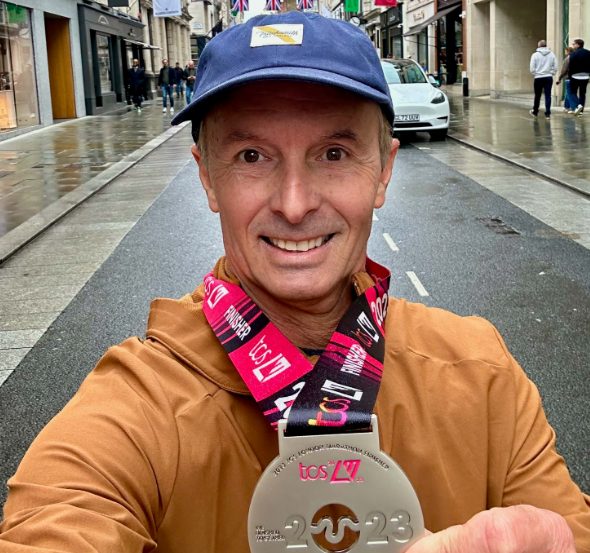
Marathon runners love to dream big on race day, whether that’s finishing with a PB, scoring a qualifier, or completing 42,2K for the first time. But for all the focus that you put into your training, nutrition, and gear, your race pacing plan can make or break your whole day.
When it comes to the best way to pace a marathon, Dave Masterson, a 61-year-old pace group leader who has run more than 70 marathons, says a straightforward strategy helps the most runners achieve their best times.
…you’ll find out the tried-and-true pacing strategy Masterson swears by…
Masterson, author of the forthcoming book, Marathon 101: Lessons & Strategies From a Professional Pacer on How to Run Your Personal Best, has developed a reputation as an upbeat, chatty pacer who can keep a group calm in the early kilometres and motivated to power through the later ones. He’s more than just a guy holding a sign with a time goal written on it. He’s a strategist, coach, and morale booster who will stop at nothing to help his group cross the finish line feeling strong.
“I just really enjoy doing it,” Masterson says. “I think running with a pacer is such a benefit, and I want more people to understand that.”
Ahead, you’ll find out the tried-and-true pacing strategy Masterson swears by, and how employing it in your own marathon can help eliminate unnecessary distractions and put you in the best position to achieve your race-day goal.
Masterson’s Best Strategy for Pacing a Marathon
Masterson says doling out your energy evenly across the entire race is superior to variable split strategies.
“If you asked anyone who’s done pacing before, it’s always to approach it with an even pace in mind,” Masterson says. “Time and time again, from beginners to pros, it has always proven to be the best.”
It may seem like an old-school method, but for Masterson, it’s been his go-to strategy for decades, and it has always worked. The key to this strategy is removing variables so you can control as many aspects of your race as you can.
How to Maintain Even Splits
Masterson runs even splits by tapping into effort-based running and by checking elapsed time at each mile marker.
Of course, using the even splits strategy doesn’t mean that each kilometre of the course is identical. In large marathons, it can take several kays just to settle into your goal pace as you navigate starting line crowds. “That freaks people out,” Masterson says. “But this is normal, we’re all good.”
For example, Masterson says that if you wind up 45 seconds off goal pace after the first three kays, because of a congested start, making up just five seconds per kay over the next nine kilometres is well within your manageable effort range. Doing so will have you right back on pace before you hit the halfway mark.
Plus, there’s a benefit to being forced to start a race conservatively: It keeps your legs fresh and allows your body to ease into your goal marathon pace, instead of going too hard too soon. That restraint pays off later, when you’re better positioned to maintain pace, while others are slowing down, Masterson says.
Hills are another reality check. Masterson doesn’t want runners forcing a target pace uphill. Instead, he tells his group to focus on keeping their cadence steady and controlled as they make the climb.
“Yes, you’re going to donate some time on uphills,” Masterson says. “But so few marathons are a net uphill. Most times, what goes up will come down.” That means you want to stay composed going uphill, and then let gravity carry you slightly faster on the downhill.
In terms of assessing effort so you can maintain even splits, a general rule of thumb is beginning your race at a three or four out of 10 rate of perceived exertion (RPE), where one is barely walking, and 10 is an all-out sprint. That means it should feel really easy. Your RPE will naturally climb as you clock the kays, but at least the first half should stay within that range.
The key to even splits is also setting a smart goal marathon pace, and determining that pace starts well before you toe the line on race day. “You’ll figure out through your training that this is the pace that you can carry for a whole marathon,” Masterson says. “Your training doesn’t lie. Believe what you see [in your training log].” Basically, if you’ve trained well (and there’s no abnormal weather or unexpected environmental conditions), there’s no reason to doubt you’ll achieve the pace goal you set in training, and that you’ll be able to carry it through the entire marathon.
Why Pacing Matters
The reason even pacing works so well comes down to how the body handles effort over 42.2 kilometres. Go out too hard and your body will burn through its fuel faster than you can replace it. Eventually, that imbalance catches up to you, and you hit a wall – often around the 28km to 32km mark.
By spreading effort evenly throughout your race, you reduce the risk of depleting energy stores too quickly and give your body a chance to sustain your goal pace deep into the race. This lowers the chance of having to resort to damage control in the final kilometres.
If you execute even pacing right, you’ll cruise right through the finish line at the same speed as when you started. The best part, Masterson says, is you may still have something left in the tank as the final three (or so) kilometres approach. If you’ve cruised past the point where other runners hit the wall, that’s when you show off your true strength.
“Run the first high percentage of kays like a Prius,” Masterson says. “Be really efficient. Get the job done. You want to be a Ferrari? Save that for the last miles.”
Where Masterson sees runners get into trouble is when they abandon even pacing in favour of riskier strategies, including leaving the pace group too early because they think they’re feeling good. He often sees runners break away around the 15km mark, but says it’s risky to do that any time before the halfway mark.
Banking time – going out faster than goal pace early to build a cushion and relying on that buffer later on – is a tempting idea. But out on the course, Masterson has witnessed many runners only drastically fade later. “We’re going to see them again,” Masterson tells his pace group when someone surges ahead too soon. More often than not, he’s right.
Optimise Your Race with Masterson’s Advice
Masterson’s strategy involves no flashy gimmicks or bleeding-edge tech. It’s just you and the road, and maybe a pace group to help. Masterson offers these three pieces of advice to runners looking to employ his even pacing strategy in their next race.
1. Avoid Relying on the Pace on Your Watch
Instead of constantly monitoring the pace displayed on your watch, Masterson encourages runners to pace their efforts using the course markings or total time on your watch. The goal is to eliminate any variation that comes from your watch tracking pace and instead see the elapsed time at each kilometre marker.
For example, if you weave around the course to use the bathroom, hit water stops, and see your cheering squad, the pace on your wrist may look different from how long it actually took you to complete the marked mile. This can end up problematic if you’re shooting for a significant time goal.
“Ultimately, you’re judged by the time it takes you to complete the course, as marked,” Masterson says.
A pace band, essentially a printed chart showing your target elapsed time for each mile marker, keeps you grounded in reality. Masterson keeps his looped around his running belt, which he also uses to store his energy gels, so all it takes is a glance down at each kilometre marker to check the elapsed time with your goal time.
2. Do Your Homework on the Course
Understanding what you’re getting into before race day, in addition to disciplined pacing, gives runners the best chance to succeed. “Don’t let the course be a surprise,” Masterson says.
Find out how many hills there are on the course, and exactly where they are along the route, when you first sign up for your race (ideally months in advance), Masterson explains. That way, you can mimic the course structure in your training and arrive more prepared to conquer each hill.
Learning where the location of the course’s water stops is also crucial to planning your in-race fueling strategy.
Essentially, cutting out as many surprises as possible allows you to maintain a strong body and mind through your race, Masterson says. If you do your homework, there’s less of a chance you’ll arrive physically depleted at a water stop or mentally crushed by an unexpected hill appearing in the distance.
3. Run with a Pacer
Some runners think it’s cheating to run with a pace group—Masterson’s heard it himself. However, this way of thinking couldn’t be further from the truth. “Your legs took every step,” Masterson responds. “All I did [as a pacer] was guide you.”
That guidance can sometimes prove crucial to a PB. As a pacer, Masterson gives runners in his groups real-time reassurance that they’re on the way to hitting their time goal.

Early in the race, Masterson talks to the runners in his group, asks questions, and keeps things relaxed. Later, when he notices the pack quiet down as effort levels rise, he becomes the group’s motivator, encouraging everyone to stick with him by reminding them of their end goal.
During the last few kilometres, he pushes the runners in his group to pass him by and cross the finish line feeling their best and under their goal time.
Masterson’s goal is to guide as many people to their fastest marathons as he possibly can, using the proven strategies he’s learned from decades of marathon pacing. “I love helping people,” Masterson says. “My reason for writing this whole book is that I’m not helping enough people, and I want more people to finish with me.”
READ MORE ON: marathons training tips