
10 Exercises Run Coaches Wish You’d Do More Often
A solid strength routine can be a game-changer for speed and preventing injury.

Most runners are well aware of the fact that strength training is a key component of a well-rounded training plan. No matter your speed, fitness, or experience level, strength training is crucial in terms of reducing the risk of muscle imbalance or injury, says Britany Williams, a National Academy of Sports Medicine (NASM)-certified personal trainer.\
…these moves can help you run longer and stronger, and get you a little more excited to cross-train.
“Strength training can help maintain and build muscle in the body, which can help improve running mechanics,” says Williams, a former competitive distance runner. “It can also support your running goals and help keep you healthy and mobile for longer.”
However, adding weight training on top of an existing running programme can feel intimidating and overwhelming, especially if you don’t know what moves to add to your routine. While you have probably heard of moves like squats and lunges being great options for runners, the 10 underrated exercises listed here and recommended by certified trainers and run coaches should definitely have a spot on your workout schedule.
While they don’t get as much love as your standard strength exercises, these moves can help you run longer and stronger, and get you a little more excited to cross-train.
Exercises All Runners Should Add to Their Strength Workouts
Here, experts call out their favourite underrated exercises that they wish more runners would add to their training, including the benefits of the move, how to do it, and the best way to add to your routine.
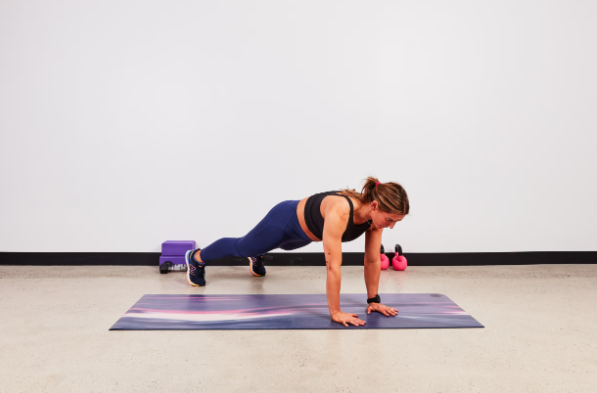
1. Weighted Plank Pull-Through

Why it works: According to Williams, plank pull-throughs are a great way to build core strength via an anti-rotational movement. That means you’re resisting rotation in the torso to keep the core (and the rest of your body) stable. “Adding in the pull-through [to a plank] will recruit more of the deep core muscles and obliques, which makes the exercise more challenging and more interesting compared to a basic plank that you may be bored with doing,” she explains. Plus, “too much rotation of the torso during running can impede proper running mechanics, so learning to connect with the core properly can be beneficial,” Williams adds.
How to do it:
- Start in a plank position, a dumbbell or kettlebell placed to the right of the torso. Place hands and feet shoulder-width apart, with shoulders directly over wrists and forming a straight line from head to heels.
- Using the left hand, grasp the weight and drag it across the floor until it is to the left of the torso.
- Place your left hand back in the plank.
- Then, grab the weight with your right hand, dragging it to the right side.
- Continue alternating. Do 2-3 sets of 6-10 reps per side.
The best time to do it: This exercise can be part of a larger strength training session or can be done as part of a core-focused routine, after an easy run, Williams says.
2. Bridge
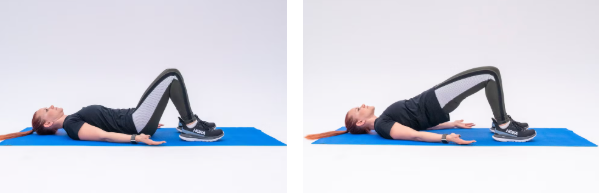
Why it works: According to Hallie Murphy, an NASM-certified personal trainer, bridges build strong glutes, back, and core. It’s a straightforward movement that fights underactivity in your glutes and can help prevent back pain. It also helps to build pelvic stabilisation and the strength you need in key areas to assist in better running.
“A perfect glute bridge consists of elevating your hips until your torso makes a straight line from your shoulder up to your knee,” Murphy says of solid form through the bridge position.
How to do it:
- Lie faceup, with knees bent and feet planted hip-width apart. Make sure toes are pointed straight forward. Place arms down by sides, palms open toward the ceiling.
- Slowly lift hips, engaging glutes, and squeezing abs. Avoid arching back.
- Once you reach the top of the glute bridge, squeeze your glutes as tightly as possible and hold for a few seconds.
- Then lower your hips back down to the floor in a controlled motion without releasing the tension in your abs and glutes.
- Repeat. Do 2-3 sets of 10-12 reps.
The best time to do it: Murphy recommends doing this exercise when you first wake up, while warming up for a run or strength workout, or incorporating it into a core routine.
3. Hip Thrust
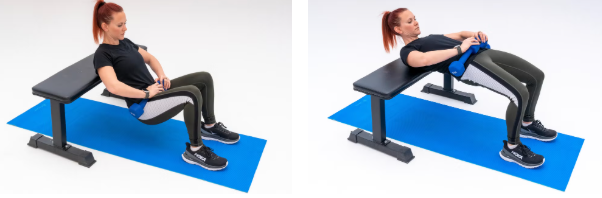
Why it works: Consider the hip thrust a step up from the glute bridge. According to Williams, hip thrusts are a great exercise for the glutes, aka the biggest muscle in the lower body that also helps runners generate speed and power and assists in moving the body forward.
“Hip thrusts can be friendlier on the knees than lunges and squats, which can be a common complaint [for those moves],” she says.
How to do it:
- Start with a chair, bench, or couch behind you, facing away from it. Place dumbbells on hips (or do this with bodyweight only). With feet flat on the ground and hip-width apart, and knees bent, align the chair so the shoulder blades are resting on top. Place hands on dumbbells or behind the head if doing bodyweight only.
- On an exhale, press weight into heels and lift hips until you form a straight line from knees to chest, bringing torso parallel to the ground. Use glutes to lift hips. Keep your chin tucked slightly so your spine stays neutral. Avoid lifting with low back.
- As you inhale, slowly lower your hips back down.
- Repeat. Do 3-4 sets of 10-12 reps.
The best time to do it: This exercise can be done as a part of a longer strength training session once or twice a week, Williams says. Make sure to warm up beforehand (light movements such as leg swings will do the trick), especially if using dumbbells.
4. Bent-Knee Calf Raise With Forward Lean
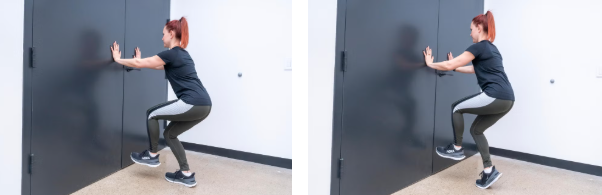
Why it works: This exercise is great for strengthening the soleus, a muscle of the calf, which works to propel you forward while running, says Anh Bui, D.P.T., a physical therapist, certified strength and conditioning specialist, and USATF Level 1 run coach.
“Runners should strengthen this muscle because a vast majority of calf strains in distance runners occur in the soleus, not the gastrocnemius (both of which make up the ‘calf complex’),” she says.
How to do it:
- Stand facing a wall and place hands on the wall at shoulder height, keeping your elbows straight. Walk feet back so fingertips are at eye level and keep head, neck, and spine in a neutral position so that you are leaning forward from the ankles.
- Lift one leg and bend the knee of the standing leg to about 90 degrees (or as low as you can go). Maintain a bent knee position as you raise onto your toes.
- Pause, then lower back down.
- Repeat. Do 2-3 sets of 8-12 reps on both sides.
The best time to do it: Bui recommends doing this exercise right before or right after your run.
5. Eccentric Step-Down
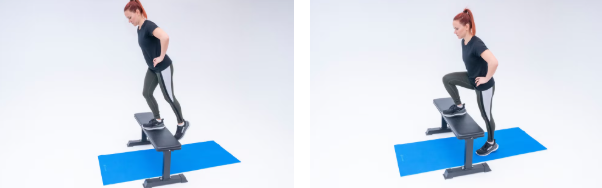
Why it works: The dumbbell step-down is a variation on the dumbbell step-up, which allows runners to train single-leg strength more efficiently, says Emily Abarquez, an NASM-certified personal trainer.
“Dumbbell step-downs and step-ups more closely mimic running strides than traditional split squats or lunges,” she explains. “The benefit of training the step-down versus the step-up is that the step-down allows for greater stability and safety while focusing on loading your hamstrings and glutes in the eccentric (lowering) portion of the movement, which will allow you to gain much more strength than focusing on the concentric (lifting) portion.”
You can start with bodyweight for this move, but then add weight. “If you can perform 15 of these with just your bodyweight on each leg, you’re ready to add a light dumbbell,” Abarquez says.
How to do it:
- Stand on top of a bench or box, on the right foot, with the left foot off the surface. (Hold onto a wall or uprights for support if you need it for the first couple of attempts.)
- Slowly lower down, on a count of 3-5, bending the right knee, and letting the left leg lower behind you toward the ground. The shin of the right working leg should remain vertical as you sit back into the bottom of the movement. Lower the left leg down toward the ground until the hips are parallel with the working knee.
- Push through the right heel to stand back up.
- Repeat. Do 2-3 sets of 8-15 reps on each leg.
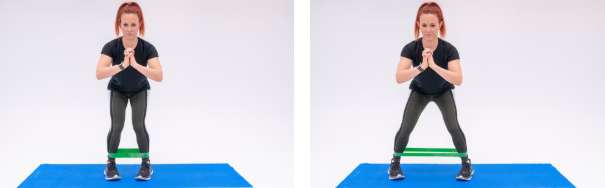
Why it works: According to Michael Clemons, a certified personal trainer and director of operations at Running USA, lateral band walks can be a game-changer when it comes to preventing injury.
“Physical therapists often use them with their patients, and I think runners need to adopt it more (before they get injured),” he says. “Runners tend to focus on moving forward, and lateral movements are important for strengthening the glutes and hips to help you stay injury-free and run stronger.”
How to do it:
- Place a resistance band around ankles and with feet about hip-width apart, point toes inward.
- Take 5-7 steps right, then 5-7 steps left.
- Repeat that sequence 5 times through.
- Rest, then repeat for another 2 or 3 rounds.
The best time to do it: This exercise is so quick and easy that you can do it at night in your living room while watching TV, Clemons says. He recommends avoiding them the night before a big workout or long run, because they work your hips pretty hard. But otherwise, incorporate them into your routine whenever you can.
7. Lateral Step-Up With Overhead Press
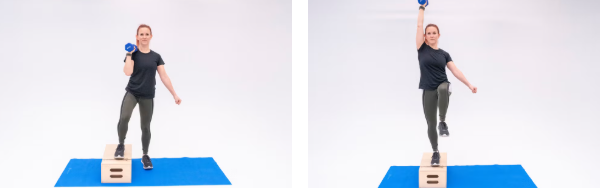
Why it works: According to Andres Padilla, a certified personal trainer, USATF level 1 run coach, and board-certified exercise physiologist in Corona, CA, total-body exercises, such as this one, increase strength and coordination in many of the muscles you use while running.
“Runners need this exercise to strengthen gluteal and hip extensor muscles, improve hip range of motion and improve neuromuscular communication between the lower and upper body,” he explains. “When your body communicates well, you can improve your speed more easily.”
If you are trying this exercise for the first time, Padilla recommends starting with a shorter step. Over time, work your way up to a 12-inch platform.
How to do it:
- Stand to the left of a step or chair, facing perpendicular to it. Hold a dumbbell in your right hand, with your elbow bent and the weight by your shoulder.
- Step up sideways onto the step. As you stand up, press the weight straight up, and bring the opposing left knee straight up. Aim to have the dumbbell and opposing knee reach their peak height at the same time.
- Slowly lower the weight back to your shoulder and step back down, left leg landing back on the ground.
- Repeat. Do 3 sets of 15-20 reps on each side.
The best time to do it: Padilla recommends doing this exercise during regular strength training sessions, two to three times per week. This is a one-sided exercise, so make sure to do the same amount of reps or time on both sides. Start with a light dumbbell and work your way up to a heavier dumbbell.
8. Banded Side Plank Clamshell
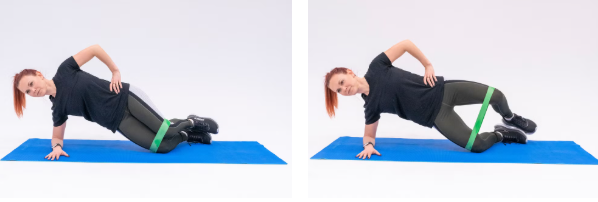
Why it works: As a general exercise, clamshells are beneficial in helping to strengthen the gluteus medius, bringing more power and stability to your hips, says Maggie Lentz, USATF level 1 run coach and American Council on Exercise-certified health coach. They’re also great for reducing the risk of injury throughout the entire lower body, giving you greater stabilisation in agility workouts, as well as more strength and power.
This compound exercise targets the abs and glutes—doing more for your body with fewer moves and time, she says. “It greatly benefits runners by being a unilateral exercise, which aids imbalance on each side of the body.”
How to do it:
- Place a resistance band above both knees. Lie on the right side with knees bent, elbow underneath the shoulder with forearm on the mat, and hips, knees, and feet stacked.
- Press into the forearm and use the obliques to lift hips as high as possible, keeping abs engaged. This is the starting position.
- Lift the top knee to open the thighs like butterfly wings.
- Then slowly lower the knee to the starting position. (Do not lower the hips.)
- Repeat. Do 2 sets of 10 reps on each side.
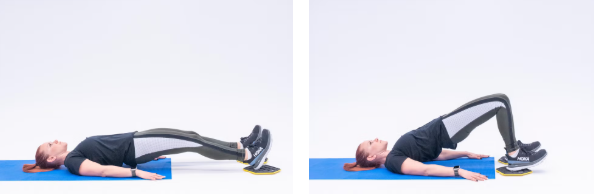
Why it works: In addition to targeting the hamstrings, this bodyweight exercise engages your core and glutes. According to Lentz, hamstring sliding curls are a beneficial exercise because your own bodyweight acts as resistance. They’re also great for runners of all levels, especially if you’re recovering from an injury.
“Running places a repetitive functional overload on the quads, therefore making this muscle group dominant,” Lentz explains. “[As a result], runners need strong, healthy hamstrings for two reasons: to avoid injury and to become stronger, and maybe faster athletes.”
How to do it:
- The hamstring sliding action of this exercise requires a pad, cloth, paper plate, or furniture sliders under the heels. You can also wear socks on a slick surface.
- Lie faceup on the floor, arms at your sides with palms down.
- Extend legs with heels on a sliding object.
- Lift glutes about 1-2 inches off the floor, squeezing muscles.
- Slide heels toward glutes until heels are under knees, and as you do so, lift hips higher.
- Pause, then slide heels back out to straighten legs.
- Repeat. Do 2 sets of 10 reps.
The best time to do it: “Hamstring sliding curls highly focus on the hamstrings while being easy on the lower back and knees, so they can also be done with a higher frequency, which is beneficial for building strength,” Lentz says. She recommends working them hard on harder running days, alternating with one-legged curls for single-sided gains.
10. Inchworm Plank
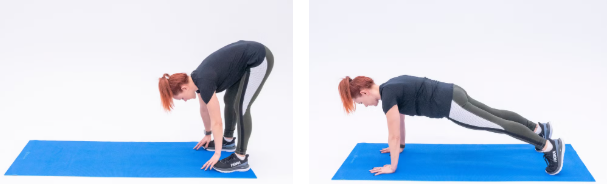
Why it works: Having a strong core and glutes is essential for all runners to perform at their best, Lentz says. This exercise targets your whole core, while strengthening the muscles of your anterior chain (the front half of your body) and stretching the muscles of your posterior chain (the back half of your body).
“Runners lose form when exhausted, and your upper body’s job is to keep you stable on a run,” Lentz explains. “The faster you run, the less time you’re in contact with the ground, which is when the upper body helps you keep your balance so you can maintain good form as you increase your pace, and without affecting your efficiency.”
How to do it:
- Stand with feet hip-width apart.
- Fold at the waist and reach arms down toward the ground.
- Walk hands away from feet into a plank position.
- Pause, then push off with arms and walk hands back to feet.
- Stand up.
- Repeat for 5-10 reps or for 30-60 seconds.
The best time to do it: Due to its strength/stretch modality, this is an excellent move to incorporate into an active warmup before strength training or high-intensity training, Lentz says.
READ MORE ON: glute activation hamstrings strength-training