
No Finishers at Barkley Marathons as Brutal Weather Takes Its Toll
For the second year running, Frozen Head showed no mercy.

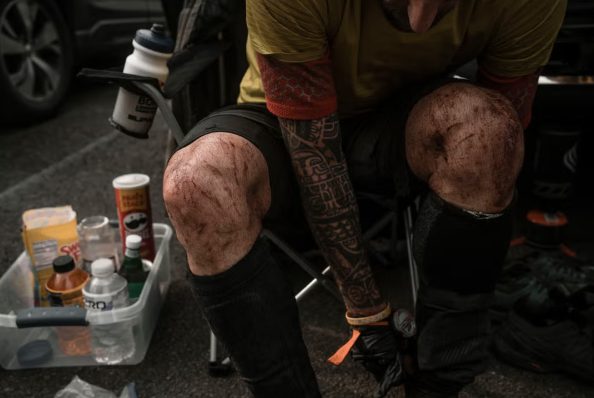
The notoriously challenging and always obscure Barkley Marathons trail running race came and went with just a whimper this year. But the 40 runners who started this peculiar event near Wartburg, Tennessee, all left in anguish.
…this year’s field of runners was chock full of highly accomplished competitors with high-profile results, including a record 10 women.
On Saturday at 6am, Barkley creator and race director Gary Cantrell, also commonly known as Lazarus Lake in the trail running world, lit a cigarette in a parking lot of Tennessee’s Frozen Head State Park, thus signalling the official start of this year’s race.
About 40 hopeful and courageous trail runners from 15 states and 15 countries set off into the park’s treacherous terrain to achieve the near-impossible amid cold, wet, muddy, foggy, and very slippery conditions.
As with every other Barkley in recent years, this year’s field of runners was chock full of highly accomplished competitors with high-profile results, including what is believed to be a record 10 women. None succeeded. After a little more than 38 hours, this year’s Barkley Marathons ended the way it has on 26 previous occasions—with zero finishers.
This was by far the earliest start of the Barkley Marathons in the 40-year history of the race, as it has typically started between mid-March and mid-April. Since its inception in 1986, the Barkley Marathons has been considered one of the hardest running events in the world, partly because it is designed for runners to fail.
It’s usually about 160km in length, consisting of five 32km loops with 12 000 feet of elevation gain through the landscape of the Cumberland Mountains. The course isn’t marked, but the terrain includes steep slopes covered in wet, slippery leaves, icy creek crossings, and infuriating brambles. This year’s Barkley reportedly had a longer course, roughly five laps of about 42km for a total of 210km. What’s more, there are no aid stations, and GPS devices and smartphones cannot be used for navigation, only paper maps and hand-held compasses.
To finish the race, runners must complete all five loops under the 60-hour cutoff, but they must also collect specific pages from old books hidden out on the course to prove they correctly completed each loop.
The Barkley Marathons has only been completed a total of 26 times by 20 runners. In 2024, British trail runner Jasmin Paris made history by becoming the first woman to ever complete the Barkley Marathons, finishing all five loops with just 99 seconds to spare in an agonising final stretch that invigorated the running world and mainstream media.
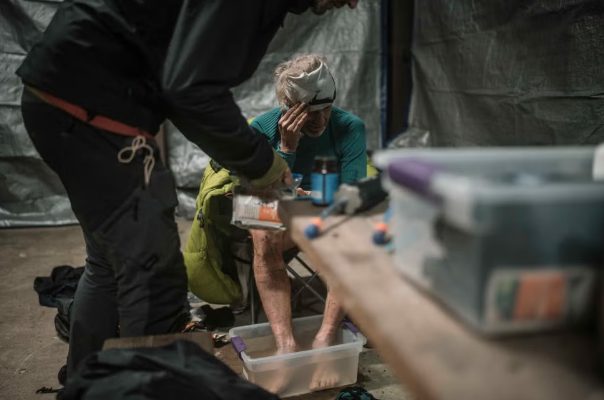
Event Background: Cantrell, 71, devised the Barkley Marathons with the odd inspiration from the 1977 escape of James Earl Ray from nearby Brushy Mountain State Penitentiary. Ray, the convicted assassin of Dr Martin Luther King Jr, and six other inmates, only travelled about 12 to 16 kilometres before being recaptured. Cantrell has said he figured he could have made it 160km, thus the theoretical basis of the race.
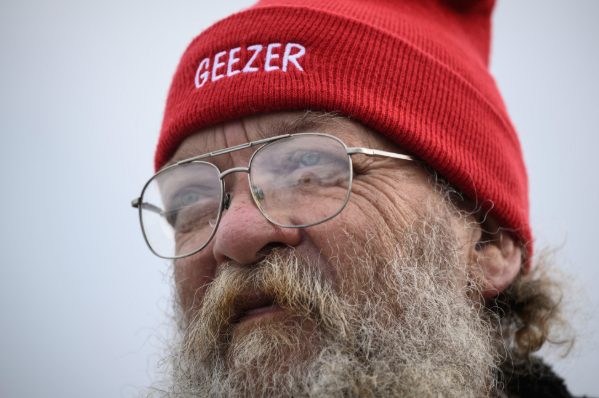
Cantrell doesn’t give out any details publicly about the race, so only the runners he accepts from the event’s application requirements know approximately when to assemble in Frozen Head State Park and roughly a 12-hour window when it will begin. Event application requirements are an essay addressing “Why I Should be Allowed to Run in the Barkley” and a R25 ($1.60) entry fee.
On the day of the race, Cantrell blows into a conch shell to give a one-hour warning before the start, but otherwise little is known, and nothing is revealed to participants until they are allowed to see the master map just before the start of the race.
Any individuals on site for the race are held to secrecy, and participant identities aren’t initially revealed by the “official” Barkley Marathons news channel – the Bluesky and X feeds of Keith Dunn. Dunn is a 66-year-old lawyer and three-time Barkley entrant from Arlington, Virginia, who has become famous in trail running circles for his exclusive but often nondescript social media posts about the event.
Among the known participants in this year’s Barkley event were Oregon’s Max King, 45, the 2011 world mountain running champion and 2014 100K world champion; Montana’s Allison Powell, 34, a finisher of numerous 100- and 200-mile races, including last year’s Cocodona 250 in Arizona; Colorado’s Paul Terranova, 52, a five-time Western States 100 finisher and two-time Hardrock 100 finisher; French-Canadian runner Mathieu Blanchard, 38, twice a podium finisher at the Ultra-Trail du Mont-Blanc in Chamonix, France, and runner-up at last summer’s Hardrock 100 in Colorado; Frenchman Sébastien Raichon, 54, winner of last month’s demanding Winter Spine Race in the UK; British runner Damian Hall, 50, a past winner of the Winter Spine Race and this year’s runner-up; France’s Aurélien Sanchez, 34, a 2023 Barkley finisher; and Tennessee’s John Kelly, 41, a nine-time Barkley starter and one of two three-time Barkley finishers.
This year, 19 runners completed the first lap, according to Dunn’s posts, but only four successfully completed two laps and started a third – King, Hall, Raichon, and Blanchard. But amid rain, fog and temperatures in the low-40s, only Raichon was able to complete it.
He finished the loop after 38 hours, 5 minutes and 46 seconds, which allowed him to earn Barkley’s sub-40-hour “fun run” status. But because he failed to complete the third lap in under the 36-hour time limit, he was unable to start the fourth lap. Hall returned 30 minutes after Raichon, but he apparently didn’t have the required book pages, so his race ended in frustration, too.
The race was profiled in the 2014 documentary, The Barkley Marathons: The Race That Eats Its Young.
READ MORE ON: 100 miler barkley marathons trail-running