
History Rewritten: Western States Sees Records Fall
Vincent Bouillard is the first runner to break the 14-hour barrier.

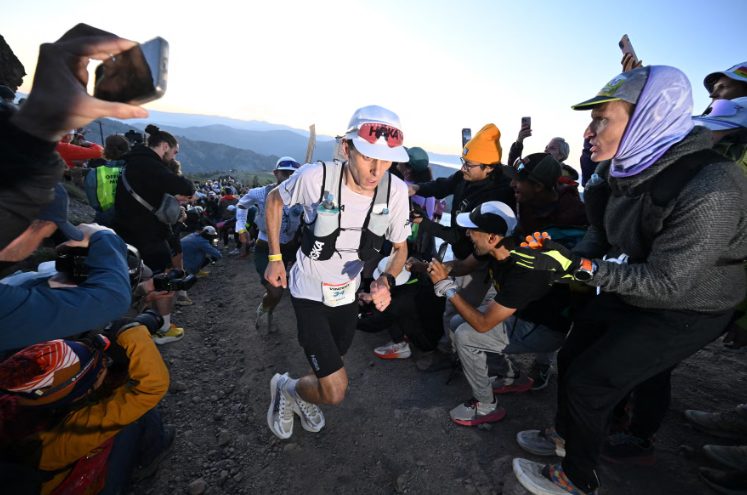
Vincent Bouillard Wins His First Western States 100, and Obliterates the Course Record By More Than 23 Minutes
Vincent Bouillard was the surprise winner of the Western States 100 on Saturday, winning the 53rd edition of the iconic ultramarathon in a stunning course-record time of 13:46:15.
The 32-year-old Frenchman shattered Jim Walmsley’s 2019 course record (14:09:28) by more than 23 minutes, becoming the fastest runner ever to complete the historic 100.2-mile (160km) journey from Olympic Valley, California, to the Sierra Nevada foothills town of Auburn in under 14 hours.
Although Bouillard wasn’t talked about as a leading contender heading into the race, his victory added another milestone to an already impressive résumé. After emerging as one of trail running’s brightest stars with his breakthrough Ultra-Trail du Mont-Blanc (UTMB) victory in Chamonix, France, in 2024, he rebounded from last year’s disappointment at Western States with a patient, calculated effort that showcased both his physical strength and tactical maturity.
Bouillard, who is coached by American Mario Fraioli, became just the seventh runner in history to win both UTMB and Western States. His course record led a remarkable men’s race in which the top four finishers all eclipsed the previous course record, highlighting the extraordinary depth of this year’s elite field.
The race also hinted at what could be a changing of the guard in men’s ultrarunning. Three of the sport’s most accomplished stars – Jim Walmsley, 36, a four-time winner and former course-record holder, Kilian Jornet, 38, the 2011 winner who was third last year, and Hayden Hawks, 35, a two-time podium finisher – were all among the leaders early on, but each saw their races end prematurely with DNFs (Jornet at mile 38, Walmsley and Hawks at mile 62), leaving the door open for new contenders to seize the spotlight.
“I think it’s going to take some time to really register,” Bouillard said after the race. “Competition is such a thing that it can go in many different ways. I’m lucky that it went well for me today. There are so many other strong competitors today, including unfortunately, some that had to drop out. I’m bummed for Jim that he couldn’t give us a true fight because he deserved better than that. And same for Kilian, too.”
Rather than forcing the pace from the 5am starting gun at the base of the Palisades Tahoe ski area, Bouillard ran a disciplined race through the cold and windy high country terrain, staying comfortably within the early lead group that included Jornet, Walmsley, and 26-year-old Hans Troyer as the course crested the 2667m summit of Emigrant Pass.
Bouillard gradually moved closer to the front as the race entered the canyons near the 40-mile (64km) mark in the late morning hours, but Troyer was still pushing the pace at the front well ahead of course-record pace. Bouillard continued to surge throughout the afternoon, maintaining a consistent pace over the demanding terrain and moderate heat while never showing signs of fading, even as Troyer eventually joined the ranks of those who dropped out.
Bouillard didn’t take the lead until he passed through the 90.5-mile (145km) Quarry Road aid station. Through the final miles along the American River and into Auburn, it became clear he wasn’t just racing for the win – he was chasing history.
“I still don’t have a ton of experience running 100-milers. I’m still figuring that out, but I wanted to try and be a little more conservative,” Bouillard said. “Despite the fact that this race always runs faster and faster and the competition is always more fierce, it’s still a 100 miles. I wanted to really keep that ingrained in my head, and keep pushing the brakes a little bit and save my legs so I could be OK with not feeling my best and to save my legs for the more runnable sections at the end.”
The win comes less than seven months after Bouillard and his wife, Camila, welcomed their daughter, Nola, into the world.
Among the breakout performances was Italy’s Francesco Puppi, whose Western States debut exceeded even lofty expectations. After earning his golden ticket with an impressive victory at CCC 100K in Chamonix, France, last August, Puppi carried that confidence into the sport’s biggest stage. The 2017 mountain running world champion over the 32K distance took the lead several times on Saturday, but didn’t have enough left in the tank to battle Bouillard over the final miles. Still, his finish reinforced his status as one of trail running’s biggest international stars.
American Ryan Montgomery also continued his rapid ascent with another standout performance. After breaking through with seventh-place finishes in 2023 and 2025, he returned noticeably stronger and more confident, running aggressively near the front for much of the day before securing a career-best third-place finish in 13:53:55. The 32-year-old New Hampshire-based ultrarunner started strong and moved up all afternoon to secure his first podium finish in a time that was nearly two hours faster than his previous best.
“I knew that I wanted to have a good day, and I definitely feel like I got it. I feel so happy right now,” Montgomery said. “I knew that it was going to be a course-record day today, and I think what I’ve learned about Western States is that when you lose contact, it’s almost impossible to reel people in, especially when you lose that pack. So my strategy was just to run aggressively from the beginning, but also to be a little bit smart. And I felt like what felt natural for me was to be in a chase pack. I don’t think I could have executed it better than I did.”
Bouillard’s 31-year-old countryman Thomas Cardin of Cognin, France, finished fourth in 14:07:58, while American Zach Miller placed fifth in his Western States debut in 14:20:09.
Jennifer Lichter Wins Western States and Breaks Courtney Dauwalter’s Course Record
Jennifer Lichter ran the first 100-mile race of her career and announced her presence with authority on the world stage. The 30-year-old runner from Missoula, Montana, turned in one of the greatest performances in the sport’s history by winning the Western States 100, covering the rugged course from Palisades Tahoe ski area in Olympic Valley, California, to the Placer High School track in the foothills town of Auburn 100.2 miles away in a new course-record time of 15 hours, 28 minutes, 5 seconds.
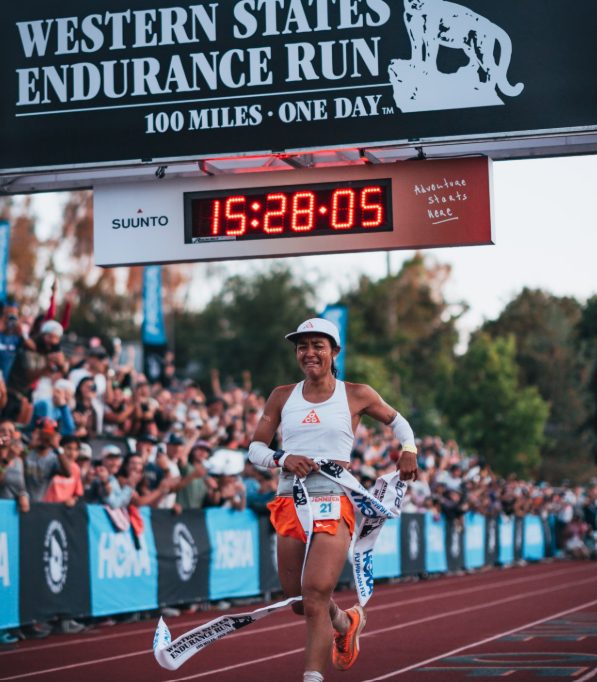
To do so, she had to outrun a talented cast of runners that included last year’s winner Abby Hall, several runners with previous top-10 finishes, and Molly Seidel, the 2020 Olympic bronze medalist who was also running her debut 100-miler. Lichter broke the seemingly untouchable 2023 course record set by Courtney Dauwalter (15:29:33).
Lichter has been a strong trail runner for several years at relatively shorter distances with an aggressive front-running style that helped her earn a fourth-place finish in the 45K race at the 2023 World Mountain and Trail Running Championships in Innsbruck, Austria. After winning several races in the 50K (31-mile range), she began moving up in distance later that year, winning the JFK 50-miler (80km) near Washington DC and several other races last year. However, she missed the opportunity to run in the world championships in Spain after a hard fall during training.
Her big breakthrough came this year after she signed on to be a part of Nike ACG’s new trail running squad. Working with Montana-based coach John Fitzgerald, she continued to expand her long runs and weekly mileage while also building strength and durability for more rigorous ultra races.
It all paid off at the Black Canyon Ultras 100K on February 14 in Arizona, where she broke the course record (7:57:05) and earned a golden ticket into this year’s Western States 100. She followed that up with a record-setting performance at the Gorge Waterfalls 50K in Cascade Locks, Oregon.
But knowing she’d be making her 100-mile debut in the country’s most competitive and prestigious trail race, she ditched her typical front-running style and ran more conservatively. She was one of the first to reach the top of the massive 4-mile climb at the start of the race from the Palisades Tahoe ski area.
Although she was among the first women to crest 2667m Emigrant Pass amid windy and cold conditions, she backed off the pace and let other runners dictate the speed for the next several hours and was instead content to settle in and let the miles go by.
“Once we went over the top, I just put the brake pedals on essentially,” Lichter said. “I knew it was going to be a very long day. I knew it was my 100-mile debut, and I just kept telling myself, ‘all day pace, all day pace.’ I wanted to start at a pace I could finish at, and so I just kept checking in within myself and asking, ‘Is this sustainable?’ And that required me to let go of girls who were passing me or running a little faster. I just kept telling myself to ‘trust the process and to trust yourself, you’re really fit, and if for some reason you don’t end up getting the win or the podium, then it was just not your day. But I knew I wanted to give it my all, and I did. But that required also being really smart.”
As a child, Lichter and her sister and brother were found homeless on the streets of Bogotá in her native Colombia. They were placed in an orphanage and, when Lichter was 9 years old, the siblings were adopted by a couple in La Crosse, Wisconsin, where they learned English and gained family structure. In middle school, Lichter discovered a much-needed outlet on the track, but she also hit several low points in a years-long struggle with disordered eating.
Lichter went back and forth in the lead on Saturday with several other top runners throughout late morning hours and early afternoon before passing her ACG teammate Riley Brady, 31, of Boulder, Colorado, and taking the lead for good near mile 48 (77km) at the Devil’s Thumb aid station. Brady, a runner who identifies as nonbinary, remained close, but Lichter pulled away after wading across the American River at mile 79 (127km) and picked up the pace considerably over the final 21 miles (33km).
With a fast final mile, Lichter edged Dauwalter’s seemingly untouchable course record by 88 seconds and finished in 11th place overall.
“I kept saying ‘steady all day, steady all day,’ but for the final 20 miles (32km) I turned my 50K racing brain on and just said, ‘I’ve got to send it now,’ and that’s what I did,” she said. “I changed shoes for the most runnable part and then just took off, and I felt amazing. It didn’t really start to hit until the Pointed Rocks aid station (mile 94.3/151km), where I was like, ‘Oh, I am feeling this really bad,’ and I did cry a little bit, but that’s what running Western States is all about.”
The third time proved to be the charm for Brady, who charged to a runner-up finish in 15:42:14 – the third-fastest women’s time in Western States history – after placing 14th in 2023 and dropping out of last year’s race. Brady spent much of the day trading the lead, overcoming a remarkable series of setbacks that included temporarily losing vision in one eye due to an electrolyte imbalance and enduring repeated bouts of vomiting over the final third of the course.
Canadian runner Marianne Hogan took third in 15:51:44, adding another podium finish to her strong Western States résumé. After finishing third in both 2022 and 2025, Hogan once again demonstrated why she has become one of the race’s most consistently outstanding performers, delivering another composed and resilient effort on the trails from Olympic Valley to Auburn. Andorra’s Caitlin Fielder was fourth (15:57:09), followed by German-born American Lotti Brinks (16:04:38) in fifth.
Molly Seidel, meanwhile, had intended to run conservatively in her first 100-mile run. She was in 10th place among women for much of the first half of the race, but she arrived at the 55.7-mile Michigan Bluff aid station suffering from sore feet, fatigue, and other elements. She took her time to change shoes, rehydrate and refuel at that aid station, but lost several places in the process. Seidel ran much slower the rest of the way, but she still managed to finish the race in 28th place among women (142nd place overall) in 24:29:27 at 5:29 a.m., just before the sun rose for the second time during the race but well ahead of the 30-hour cutoff.
Abby Hall, last year’s champion in 16:37:16, which was at the time the fourth-fastest women’s time in the race’s history, was in 10th place early in the race. But the 35-year-old runner from Flagstaff, Arizona, struggled as temperatures rose into the upper 70s and eventually dropped out at the 80-mile mark just after crossing the river.
These articles first appeared on the Runner’s World USA Website.
READ MORE ON: 100 miler western states 100